
Son las 2:00 a. m. en Anthem y, aunque las estrellas del desierto son hermosas, el aire a 38 grados Fahrenheit (3 °C) que se cuela por sus ventanas...
How to Improve Your Home’s Heating & Cooling in Las Vegas: The Caribbean AC Guide
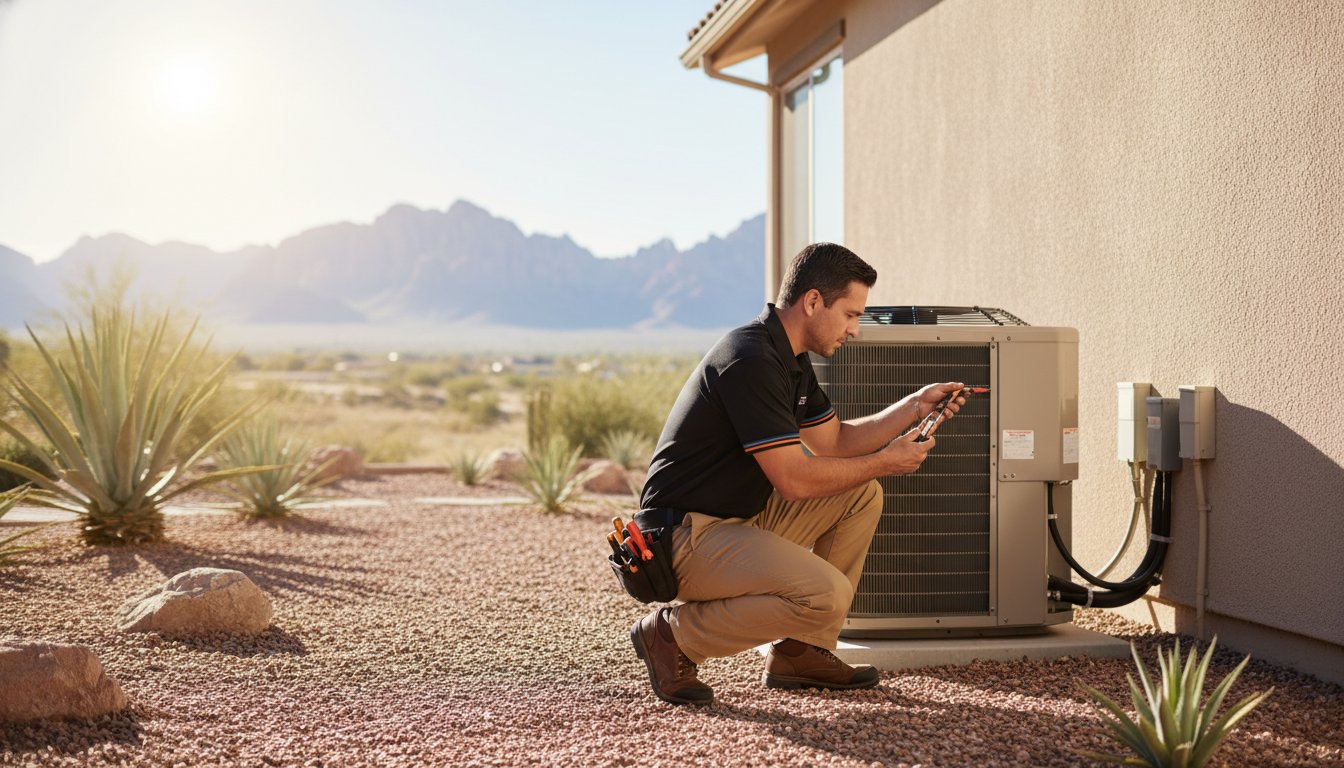
Imagine it is 3:00 PM on a Tuesday in July, and your Summerlin home is sitting at 82 degrees despite the AC running for six hours straight. Outside, the Las Vegas heat has climbed to 115 degrees, and you know your next NV Energy bill will likely exceed $450. You aren’t alone in this struggle. Many homeowners are searching for exactly how to improve Caribbean Heating & Cooling systems to survive the desert’s most demanding months. Fine desert dust can clog your coils and reduce system efficiency by 20% in a single season, leading to those frustrating hot spots in upstairs bedrooms.
We agree that nobody should have to choose between a comfortable living room and a manageable monthly budget. This guide provides professional strategies to lower your utility costs by up to 25% while providing reassurance that your unit won’t fail during a record-breaking heatwave. You’ll discover a clear plan for simple DIY maintenance and when to call in the experts at Caribbean Air Conditioning for a professional performance boost. We’ll walk through everything from duct sealing to thermostat optimization to give you total peace of mind this summer.
Key Takeaways
- Master the specific thermostat configurations and operating modes required to maintain home comfort and efficiency when Las Vegas temperatures exceed 100 degrees.
- Understand the vital link between indoor air quality and system longevity to protect your family’s health while reducing unnecessary mechanical wear and tear.
- Discover professional strategies on how to improve Caribbean Heating & Cooling performance with proactive maintenance schedules that guard against emergency summer failures.
- Learn how to identify the critical signs that it is time to transition from costly repairs to high-efficiency SEER2 upgrades for maximum long-term energy savings.
The Las Vegas Climate Challenge: Why Standard Cooling Isn’t Enough
While our brand name evokes the breezy, humid shores of the Cayman Islands, we recognize that the Las Vegas Valley presents a radically different set of environmental demands. In the Caribbean, we battle salt air and high moisture levels. In Southern Nevada, we face a relentless 115°F furnace that tests the absolute limits of every residential Heating, ventilation, and air conditioning (HVAC) system. Understanding how to improve Caribbean Heating & Cooling starts with acknowledging that desert life requires more than just a standard “out of the box” air conditioner. You need a system tuned for the extremes of the Mojave.
Standard cooling units designed for temperate climates often struggle here because they aren’t calibrated for the 40 degree temperature differential required during a typical Vegas July. A well-performing system in Nevada must maintain a consistent 20 degree “split” between the return air and the supply air. When the sun beats down on your roof for 14 hours straight, your equipment works 30 percent harder than a similar unit in a coastal region. We focus on bridging this performance gap through specialized local maintenance and precise calibration that accounts for our unique topography.
Desert Heat vs. Tropical Humidity
The primary difference between an island climate and the Mojave is the “Wet Bulb” temperature. In the Caribbean, high humidity makes 85°F feel like 100°F. In Las Vegas, the humidity frequently drops below 8 percent during the peak of summer. This dry heat causes moisture to evaporate off your skin instantly. While this helps with natural cooling, it also means your AC system focuses almost entirely on “sensible cooling” rather than dehumidification. If you are looking for ways how to improve Caribbean Heating & Cooling in Henderson or Green Valley, you must ensure your system is charged correctly. Low humidity can make your indoor air feel “thin,” requiring precise airflow adjustments to maintain true comfort.
The Impact of Mojave Dust on System Longevity
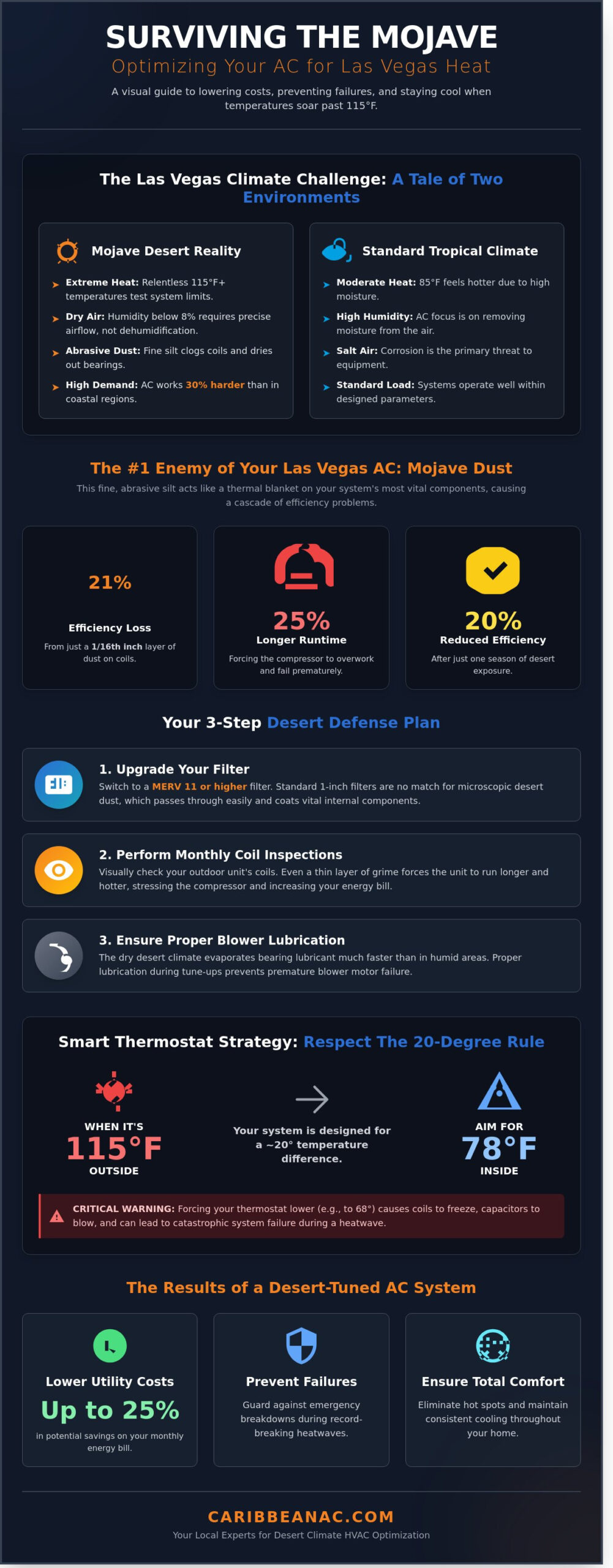
Fine desert silt is the primary enemy of Nevada HVAC units. Unlike the heavy, wet sand found on tropical beaches, Mojave dust is microscopic and highly abrasive. It penetrates standard 1 inch pleated filters with ease. In North Las Vegas, where constant new construction disturbs the desert floor, this silt coats the outdoor condenser coils rapidly. This layer of grime acts like a thermal blanket. It forces the compressor to run 25 percent longer to achieve the same cooling effect, which leads to premature component failure. Homeowners in Summerlin face unique challenges as well. The higher elevation and increased wind speeds drive dust deep into the blower motor assembly. To protect your investment, we recommend the following for desert homes:
- Upgrade to MERV 11 or higher: Standard filters cannot trap the fine silt common in the valley.
- Monthly Coil Inspections: A 1/16th inch layer of dust can reduce efficiency by 21 percent.
- Blower Motor Lubrication: Desert dust dries out bearings faster than in any other climate.
By addressing these specific desert factors, you move beyond basic cooling and into true home climate management. We don’t just fix units; we optimize them to survive the harshest conditions in the United States.
Optimizing Your AC Modes and Thermostat Settings for Efficiency
Understanding How to improve Caribbean Heating & Cooling efficiency starts with mastering the interface on your wall. In Las Vegas, where summer temperatures frequently exceed 105 degrees, your thermostat settings determine whether your system survives the season or suffers a premature breakdown. Most homeowners set a temperature and forget it, but proactive management can reduce wear on your compressor by up to 20% during peak heatwaves.
The “20-degree rule” is a fundamental principle of HVAC physics you must respect. Most residential systems are designed to create a 20-degree difference between the outdoor ambient air and the indoor supply air. When it is 115 degrees in Summerlin or Henderson, your AC will struggle to maintain 68 degrees. Forcing the unit to hit that target causes it to run indefinitely, leading to frozen coils or blown capacitors. Aim for a target of 78 degrees when you’re home to keep the system within its safe operating parameters. If your home won’t stay cool even with proper settings, check our AC repair Las Vegas troubleshooting guide to identify potential mechanical failures.
Mastering AC Modes in a Dry Climate
The choice between “Fan On” and “Auto” is critical. You should almost always choose “Auto.” When the fan is set to “On,” the blower runs continuously even when the cooling cycle ends. In our desert climate, this can actually pull warm, unconditioned air into your home and increase internal humidity by evaporating moisture off the cooling coils back into the house. Use “Cool Mode” as your primary setting. While “Dry Mode” is often associated with tropical climates, it is incredibly effective during the Las Vegas monsoon season in July and August. It allows the system to prioritize moisture removal without over-chilling the room.
Smart Thermostat Strategies for NV Energy Customers
Smart thermostats are the best defense against high utility bills. NV Energy customers can take advantage of Time-of-Use rates by pre-cooling their homes. Set your thermostat to 72 degrees at 10 AM, then let it rise to 79 degrees during the peak window of 1 PM to 7 PM. This strategy turns your home’s structure into a “thermal battery,” keeping you comfortable while the grid is most expensive. These devices also prevent short-cycling, which occurs when a system turns on and off every few minutes. Short-cycling is a primary cause of motor failure. Improving indoor air quality through high-MERV filtration also helps maintain steady airflow, which supports these smart settings. If you haven’t upgraded your controls yet, you can request a smart thermostat installation to gain 24/7 monitoring and peace of mind.
Effective management of How to improve Caribbean Heating & Cooling performance relies on consistency. Avoid drastic temperature swings. Setting your “Away” temperature more than 7 degrees higher than your “Home” temperature is a mistake. It often takes a standard 3-ton unit over 4 hours to recover that much heat, which consumes more energy than simply maintaining a steady, slightly higher temperature all day.
Improving Indoor Air Quality to Reduce System Strain
Indoor Air Quality (IAQ) measures the health, cleanliness, and comfort of the air inside your home. In the Mojave Desert, IAQ is a critical factor for your comfort and your equipment’s lifespan. Dust and pollen in North Las Vegas and Henderson act like sandpaper on your HVAC components. When your system pulls in debris, it works harder and wears out 15% faster on average. High-quality filtration and UV lights act as a shield for your investment. UV lights neutralize biological contaminants before they build up on your evaporator coil. This keeps the heat exchange process efficient and prevents the “dirty sock” smell common in older units. If you want to know how to improve Caribbean Heating & Cooling, start by keeping the internal components clean. Clean systems run smoother. They last longer. You save money on monthly bills while breathing easier. Following Department of Energy efficiency tips for maintenance ensures your system doesn’t struggle against preventable clogs.
Choosing the Right MERV Rating for Your Filter
Many homeowners think a higher MERV rating is always better. That isn’t always true for older Las Vegas units. A MERV 13 filter captures 90% of particles, but it’s very dense. This density can restrict airflow, causing the blower motor to overheat and fail prematurely. We often recommend a MERV 8 or 11 for standard residential systems to balance filtration with necessary air volume. If you have pets or suffer from seasonal allergies, change your filters every 30 days during the peak summer and winter months. For homes without pets, a 90-day interval is usually sufficient to maintain peak performance and avoid unnecessary system strain.
Humidity Control: The Silent Comfort Factor
Nevada’s air is notoriously dry, often dropping below 10% humidity during the winter. This dryness makes you feel colder than the actual temperature because moisture evaporates off your skin faster. By adding a whole-home humidifier to your Caribbean AC system, you can maintain a comfortable 35% humidity level. This small adjustment allows you to set your thermostat to 78 degrees while it feels like a cool 72 degrees. You’ll stop the annoying static shocks and dry skin issues that plague local families every January. Integrating these solutions is a proven way how to improve Caribbean Heating & Cooling performance during the harshest desert stretches while reducing the load on your heater.
Maintenance Strategies to Boost Your HVAC Performance
Las Vegas summers test the limits of every mechanical system. When temperatures hit 100 degrees by mid-May, your air conditioner often runs for 18 hours a day or more. Knowing how to improve Caribbean Heating & Cooling performance starts with a proactive maintenance strategy that separates simple chores from technical calibration. While homeowners can manage basic upkeep, professional intervention prevents the 90% of system failures that typically occur during the peak of July heat.
A “Spring Tune-Up” isn’t just a suggestion; it’s a necessity for desert living. Scheduling this service before the first 115-degree day ensures that small issues, like a worn capacitor or a slightly loose fan belt, don’t turn into a total system collapse when you need cooling the most. This proactive approach saves you from the stress of emergency repairs and the discomfort of a sweltering home.
This principle holds true in any region with extreme temperatures; for example, residents in Florida’s challenging humid heat often turn to trusted providers like Al-Air to ensure their systems are ready for summer.
The Professional Maintenance Checklist
Professional service goes beyond a quick visual inspection. Our technicians focus on the internal components that sustain high-pressure operation during the intense Nevada summer. We use specialized tools to ensure every part of your system meets manufacturer specifications.
- Refrigerant Analysis: Even a 10% loss in refrigerant can increase your monthly energy bills by 20% and cause the compressor to overheat. We identify and repair leaks rather than just adding more gas.
- Electrical Integrity: We tighten every terminal and connection. The extreme heat in Las Vegas causes metal to expand and contract, which loosens connections and creates fire hazards or motor failure.
- Drain Line Clearing: We flush the condensate lines to remove algae and dust buildup. This prevents water from backing up into your home’s closets or attic, which can cause over $2,500 in property damage.
Preventing water damage is a critical aspect of home maintenance, regardless of the source. While this guide focuses on AC-related issues, hidden plumbing problems can be just as destructive. For those interested in understanding other potential risks, you can explore Slab Leak Detection and Repair to see how experts in other regions handle foundation-level water issues.
Homeowner DIY: What You Should (and Shouldn’t) Do
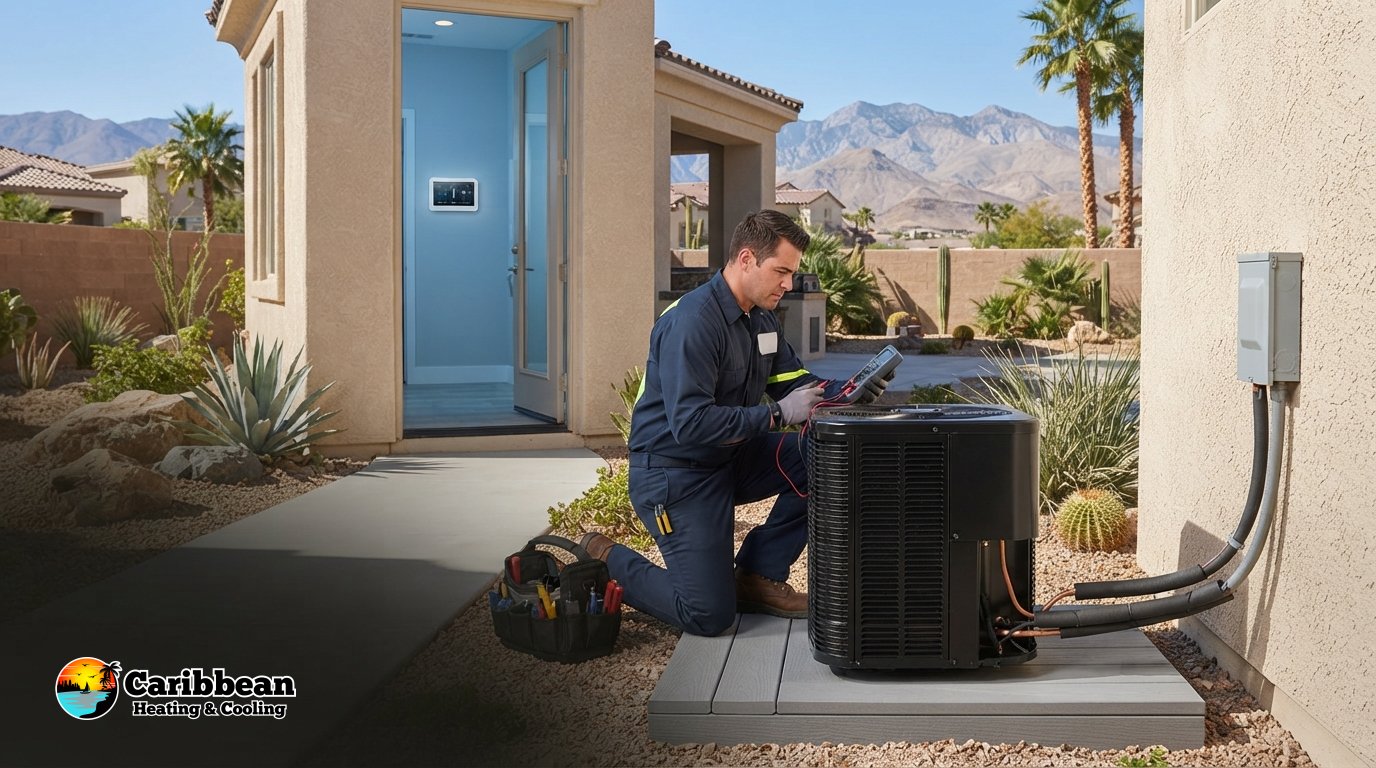
You play a vital role in system longevity by maintaining the environment around your equipment. Learning how to improve Caribbean Heating & Cooling efficiency involves keeping the exterior unit, or condenser, free from obstructions. Ensure there’s a 24-inch “dead zone” around your outdoor unit. Remove desert scrub, wind-blown debris, or storage items that block airflow and force the motor to work harder.
You can safely wash your outdoor coils using a low-pressure garden hose to rinse away desert caliche and dust. Never use a power washer; the high pressure will flatten the delicate aluminum fins and permanently restrict airflow. Most importantly, never attempt to “recharge” your own refrigerant. Handling chemicals like R-410A requires EPA certification. Improper levels will destroy your compressor within 48 hours, leading to a total system replacement.
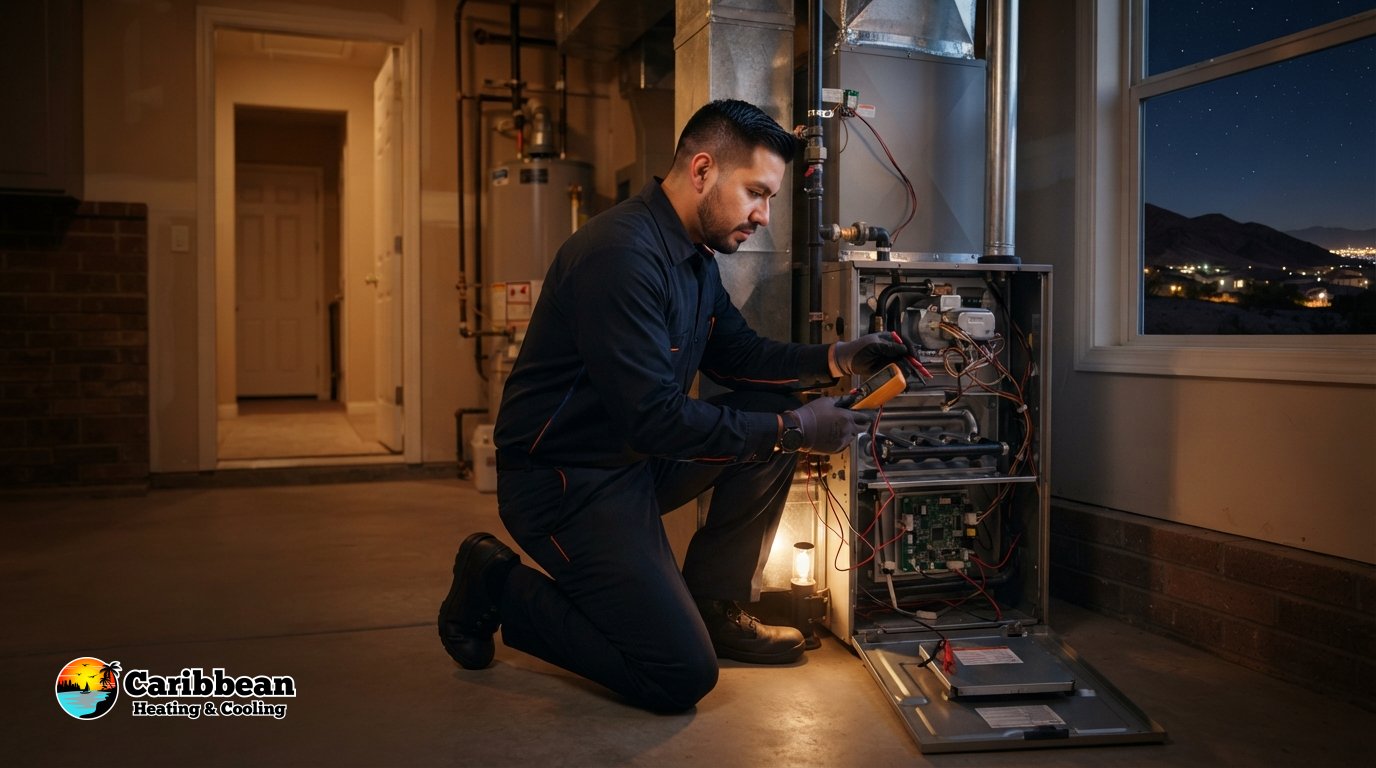
Don’t ignore the furnace during the warmer months. Las Vegas winter nights often drop to 35 degrees. A cracked heat exchanger or a faulty igniter can leave you freezing at 3:00 AM. Regular inspections ensure your heating cycle is safe and carbon-monoxide free before the first frost hits in late November.
Protect your investment and your comfort by booking a professional inspection. Schedule your comprehensive system tune-up today to ensure your home stays reliable all year long.
Professional Upgrades with Caribbean Heating & Cooling
Deciding when to stop patching up an old unit is a critical financial choice for any Las Vegas homeowner. If your repair costs exceed 50% of the system’s total value or your unit has surpassed the 12 year mark, you are likely throwing money into a sinking ship. Modern units offer immediate relief from the 115 degree summer peaks. Learning how to improve Caribbean Heating & Cooling performance in your specific residence often begins with moving away from outdated R-22 refrigerants toward eco-friendly, high-efficiency alternatives that slash monthly utility bills.
The transition to SEER2 standards on January 1, 2023, changed the game for Nevada residents. New systems must meet a minimum of 14.3 SEER2 in the Southwest region. Upgrading from an older 10 SEER unit to a 16 or 18 SEER2 system can reduce your cooling costs by approximately 30% annually. We provide 24/7 emergency support because we know a breakdown in July isn’t just an inconvenience; it’s a safety risk for your family. Our team is ready to restore your peace of mind at any hour.
High-Efficiency Systems for the Mojave Desert
Henderson residences often benefit from the debate between heat pumps and traditional gas furnaces. While gas furnaces provide intense heat, modern heat pumps are 300% more efficient in the mild Las Vegas winters. Multi-stage compressors are essential here. Unlike single-stage units that stay at 100% power, multi-stage systems fluctuate their output to match the 20 degree temperature swings common in the desert. You can currently access federal tax credits up to $2,000 for heat pump installations under the Inflation Reduction Act, alongside local NV Energy rebates that often reach $500 for qualifying equipment.
While these strategies apply to residential settings, the principles of energy efficiency scale up significantly for commercial properties. Business owners interested in advanced energy management systems and commercial refrigeration hardware can find relevant resources and distribution information at coolriteems.com.
Why Choose Caribbean Heating & Cooling?
We are a family-owned, locally licensed contractor focusing exclusively on residential comfort. We don’t let commercial projects distract us from your home’s needs. Our expertise is tailored to the specific demands of local zip codes from 89101 to 89148. We understand how the dust and heat of the Mojave impact your ductwork and internal components. Understanding how to improve Caribbean Heating & Cooling reliability starts with a professional touch. You can book your 2026 performance evaluation and comprehensive system audit today to ensure your home remains a sanctuary. Our residential-only focus means your comfort is always our primary mission.
Secure Your Home Comfort Against the Las Vegas Heat
Living in the Las Vegas Valley means facing summer temperatures that frequently exceed 110 degrees. You need more than just a basic cooling unit; you need a system specifically optimized for extreme desert conditions. By fine-tuning your thermostat modes and prioritizing indoor air quality, you can reduce system strain and lower monthly energy costs by 15 percent. Consistent preventative maintenance is the most effective strategy to avoid a total system failure during a record-breaking heatwave.
Our team has served local homeowners as a family-owned and operated business since 2018. We provide licensed HVAC expertise across the entire Las Vegas Valley, ensuring your living space remains a sanctuary. If you want to know how to improve Caribbean Heating & Cooling performance in your specific floor plan, professional calibration is the answer. We offer 24/7 emergency residential support because we know that mechanical issues don’t wait for business hours. We’re committed to providing the reliability your family deserves.
Schedule Your Las Vegas Home Comfort Audit with Caribbean Heating & Cooling Today
Your long-term comfort is our mission, and we’re ready to help you beat the heat with confidence.
While ensuring your home is a comfortable sanctuary is crucial, sometimes the best reward for all that upkeep is planning a well-deserved family getaway. For those considering a trip to the popular attractions in Florida, finding accommodations that also prioritize comfort is key. As an example of a luxury stay, Heroes Vacation Home offers villa rentals designed for a relaxing escape.
Frequently Asked Questions
Is it better to leave my AC on all day in Las Vegas?
Yes, it’s generally more efficient to leave your AC running at a consistent temperature during a Las Vegas summer. When you turn the unit off, your home’s internal temperature can rise by 15 degrees, forcing the system to work at maximum capacity for 4 hours to cool it back down. We recommend setting your thermostat 5 degrees higher while you’re away to maintain efficiency without overworking the compressor.
How much does a new AC installation cost in Henderson, NV?
A new AC installation in Henderson typically costs between $5,000 and $12,000 depending on the unit’s SEER2 rating and your home’s square footage. For a standard 1,800 square foot home, a 3.5-ton system usually falls in the middle of that range. This investment includes the unit, labor, and necessary permits. We provide detailed quotes to help you understand how to improve Caribbean Heating & Cooling efficiency through modern equipment.
Can I improve my AC efficiency by shading the outdoor unit?
You can improve efficiency by up to 10% by shading your outdoor condenser unit, provided you maintain 24 inches of clear space for airflow. If you block the unit’s intake or exhaust, the system will overheat and consume 15% more energy. Use a trellis or plant tall shrubs at least 3 feet away to provide shade without creating an air trap that damages the motor and reduces its lifespan.
What is the best thermostat setting for a Las Vegas summer?
The Department of Energy recommends setting your thermostat to 78 degrees Fahrenheit when you’re home during the day. For every degree you raise the temperature above 72, you can save roughly 3% on your cooling costs. If 78 feels too warm, use ceiling fans to create a wind-chill effect that makes the room feel 4 degrees cooler. This strategy keeps your energy bills manageable during the 110-degree July heat.
How often should I have my HVAC system serviced in North Las Vegas?
You should schedule professional HVAC maintenance twice a year, once in March and once in September. Regular service can prevent 85% of common equipment failures and extends the lifespan of your system by 4 years. Our technicians check refrigerant levels, clean coils, and inspect electrical components to ensure your home remains a sanctuary. This proactive approach keeps your system running smoothly during the most demanding months of the year.
What happens if my AC stops blowing cold air during a heatwave?
If your AC stops blowing cold air, it’s likely due to a frozen evaporator coil or a failed start capacitor. First, check your air filter; a 30% reduction in airflow from a dirty filter can cause the system to freeze up. If the filter is clean, turn the system off at the thermostat and call us immediately. Running a malfunctioning unit can cause $2,500 in damage to the compressor.
Does Caribbean Heating & Cooling offer emergency 24/7 repairs?
Yes, we provide 24/7 emergency repair services throughout the Las Vegas valley to ensure you’re never left in the heat. We understand that a broken AC is a safety emergency when outdoor temperatures exceed 105 degrees. Our team arrives with fully stocked vans to fix 90% of common issues on the first visit. We’re the reliable partner you need for how to improve Caribbean Heating & Cooling performance at any hour.
How can I lower my heating bill during the Las Vegas winter?
You can lower your heating bill by 15% by sealing air leaks around windows and doors with weatherstripping. Set your thermostat to 68 degrees during the day and lower it by 8 degrees while you sleep. These small adjustments, combined with opening your curtains to utilize natural solar heat, significantly reduce the load on your furnace during the chilly desert nights in December and January when temperatures drop to 35 degrees.
Professional maintenance is key to efficiency in any extreme climate. For instance, while this guide focuses on Las Vegas, you can discover First Choice Plus Plumbing & Air to see how experts in Florida’s intense heat and humidity approach HVAC and plumbing solutions.
Professional maintenance is also key to efficiency. While they are based in Scotland, you can see the type of comprehensive boiler and gas services offered by specialists when you check out Gas2Heat.com Ltd.
Another strategy gaining popularity, particularly in Europe where energy costs are high, is supplemental zone heating. For those interested in exploring these international solutions, you can see examples of how people infrarood panelen kopen to heat specific rooms efficiently.

Related Posts
Comments (0)