
Al comparar los costos y beneficios del purificador de aire con luz UV para HVAC, la primera pregunta es en qué parte del sistema debe actuar. Una...
AC Replacement Las Vegas: 2026 Homeowner’s Guide to Desert Cooling
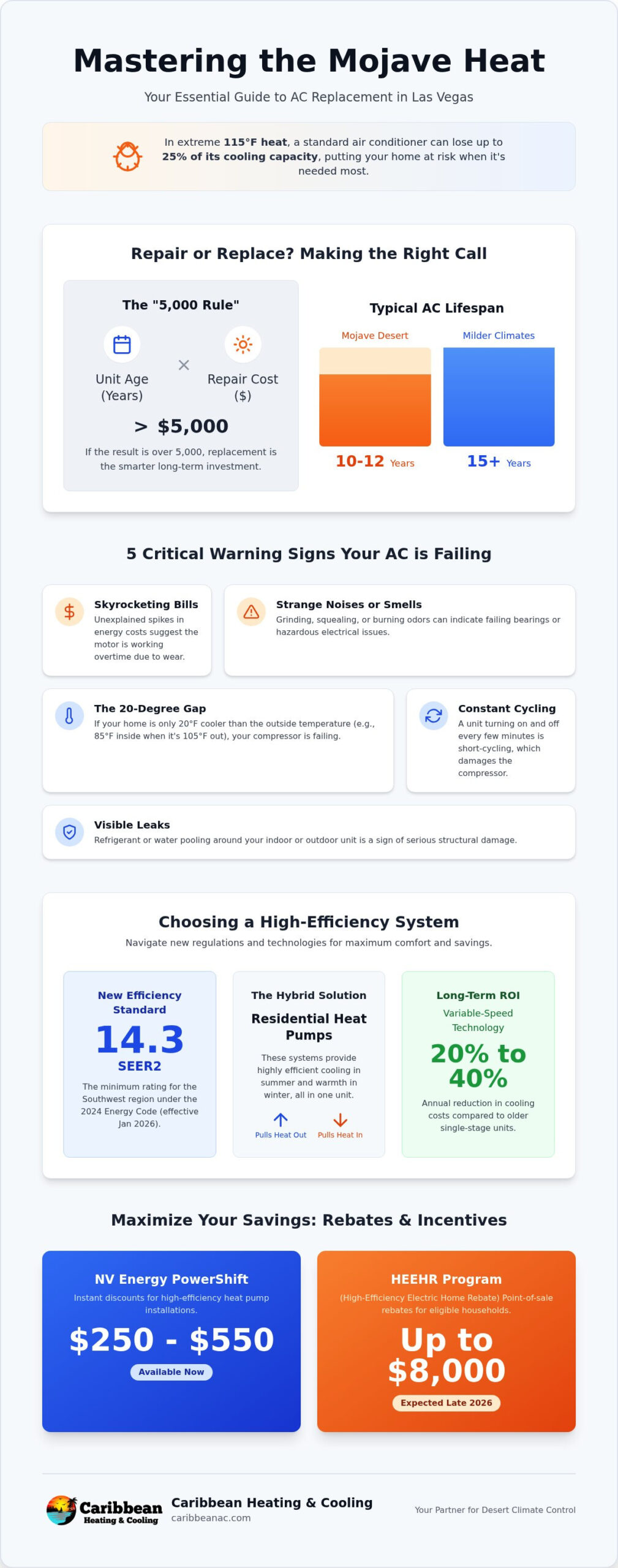
At 115°F, a standard single-stage air conditioner can lose up to 25% of its cooling capacity, leaving your home vulnerable just when the Mojave heat is most dangerous. It’s stressful to watch your energy bills climb while worrying if your aging unit will survive the next record-breaking heatwave. You shouldn’t have to choose between home comfort and your monthly budget. This guide simplifies the process of AC replacement Las Vegas, helping you choose a system that masters the desert climate while lowering your utility costs.
We’ll explore 2026 efficiency standards, explain new refrigerant regulations, and show you how to maximize local rebates for a seamless installation. From SEER2 ratings to the 2024 International Energy Conservation Code, you’ll gain the confidence to invest in your home’s long-term safety. Let’s ensure your family stays cool, no matter how high the mercury rises.
Key Takeaways
- Learn how to use the “5,000 Rule” to determine if your aging unit is a candidate for repair or if it’s time to invest in a professional AC replacement Las Vegas.
- Discover why SEER2 ratings are the new standard for measuring efficiency in the Mojave climate and how they help lower your summer energy bills.
- Explore the benefits of modern residential heat pumps as a highly efficient hybrid solution for both extreme summer cooling and winter warmth.
- Understand the full installation process, including how a dedicated local crew prepares your home and ensures your new system operates at peak performance.
Repair vs. AC Replacement: Making the Right Call for Your Las Vegas Home
Deciding between a quick fix and a full investment is a high-stakes choice in the Mojave Desert. The relentless heat puts unique stress on Heating, ventilation, and air conditioning (HVAC) systems. While units in milder climates might last 15 years, local systems typically reach retirement after just 10 to 12 years. If your unit is approaching this decade mark, evaluate its reliability now to avoid a total failure during a July heatwave.
To better understand the factors involved in this decision, watch this helpful video:
We suggest using the “5,000 Rule” as a clear tipping point for your budget. Multiply the age of your unit by the estimated repair quote; if that number exceeds 5,000, an AC replacement Las Vegas is likely the smarter long-term move. Don’t ignore the frequency of service calls, either. If you have already requested ac repair las vegas twice in one season, the internal components are likely compromised beyond a simple fix.
5 Warning Signs Your AC Unit is Reaching Retirement
Your system’s daily performance often reveals more than its age. In the desert, a struggling unit is both a safety risk and a financial drain. Watch for these five critical red flags:
- Astronomical Energy Bills: If your monthly costs spike while your habits stay the same, the motor is likely working overtime to compensate for mechanical wear.
- Strange Noises or Smells: Grinding, squealing, or burning odors suggest failing bearings or electrical issues that could lead to a hazard.
- The 20-Degree Gap: Most systems are designed to keep your home about 20 degrees cooler than the outside air. If your home stays at 85°F when it’s 105°F outside, your compressor is failing.
- Constant Cycling: A unit that turns on and off every few minutes is short-cycling, which destroys the compressor’s lifespan.
- Visible Leaks: Refrigerant or water pooling around the indoor or outdoor unit indicates serious structural damage.
Choosing a High-Efficiency System for Extreme Desert Heat
Selecting the right equipment for an AC replacement Las Vegas requires navigating new 2026 regulations and environmental standards. The transition to SEER2 testing ensures your system is rated for the actual static pressure found in Nevada homes, rather than idealized laboratory conditions. When choosing a high-efficiency air conditioner, you must adhere to the 2024 International Energy Conservation Code, enforced as of January 11, 2026. This code mandates higher efficiency levels, specifically a minimum of 14.3 SEER2 for the Southwest region.
Residential heat pumps have emerged as a top choice for local comfort. They provide a seamless cooling and heater repair solution, moving heat out of your home in summer and pulling it in during winter. We also factor in the July 27, 2026, EPA refrigerant transition, which impacts the phase-out of R-410A and determines which new systems can be installed. Proper sizing is the final piece of the puzzle. A unit that’s too large will cycle too quickly, leaving your air feeling clammy and increasing mechanical wear.
Navigating Nevada Energy Rebates and Incentives in 2026
NV Energy’s PowerShift program provides instant discounts ranging from $250 to $550 for high-efficiency heat pump installations. While the previous federal 25C tax credit expired at the end of 2025, the new High-Efficiency Electric Home Rebate (HEEHR) program is expected to launch in Nevada by late 2026. This program offers up to $8,000 in point-of-sale rebates for eligible households. Investing in variable-speed technology provides the highest long-term ROI, as these systems can reduce annual cooling costs by 20% to 40% compared to older single-stage units. If you’re ready to explore these savings, Caribbean Heating & Cooling can help you select a system that fits your home’s specific needs.
The Caribbean AC Replacement Process: What Homeowners Should Expect
Transparency matters when investing in your home’s long-term comfort. Our process begins with a meticulous pre-installation inspection where we verify your existing ductwork integrity and electrical capacity. We want to ensure your home’s infrastructure can handle the high-performance demands of a modern unit without any safety risks. While our team doesn’t offer duct cleaning, we provide a clear assessment of your current ventilation to prevent airflow bottlenecks that could strain your new equipment.
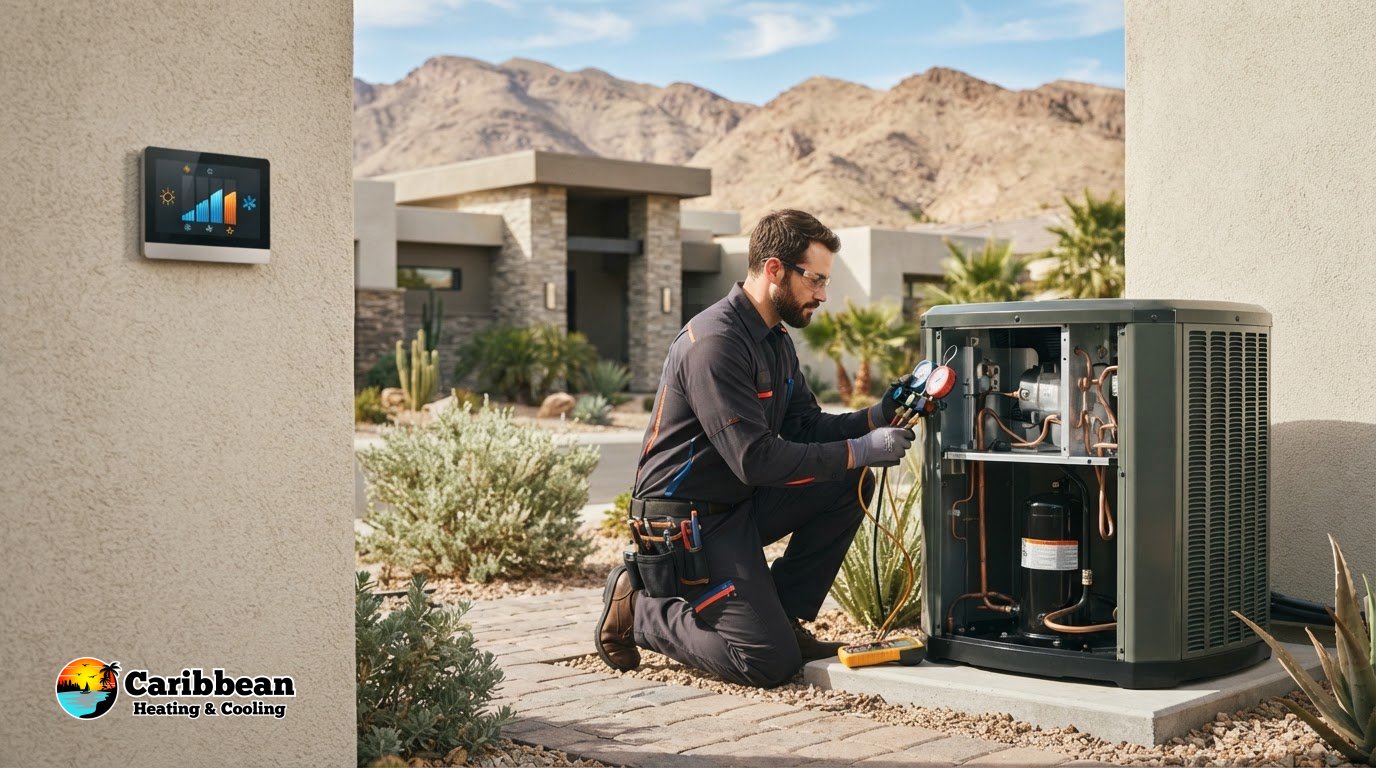
On the day of your AC replacement Las Vegas, our local crew treats your property with the highest respect. We use protective floor coverings and specialized equipment to clear out your old unit quickly and cleanly. Once the new system is secured, we perform precise system calibration. This step is vital for hvac las vegas performance. We tune the equipment to handle the extreme peak loads of a typical 115°F summer afternoon, ensuring the compressor doesn’t struggle when you need it most. Our 24/7 support remains available throughout the transition to keep your home safe.
Why a Professional Residential Installation Outperforms DIY
Attempting a DIY install in the Mojave climate is a gamble that rarely pays off. Professional installation ensures exact refrigerant charge levels, which are critical for reaching maximum cooling capacity during a record heatwave. We also integrate advanced thermostats to optimize your energy management and indoor air health. Choosing a family-owned company means you receive a dedicated labor warranty. This provides a dependable local safety net that big corporate franchises often fail to provide, keeping your family comfortable year-round with a partner you can trust.
Secure Your Home’s Comfort for the Next Decade
Deciding on an AC replacement Las Vegas isn’t just about fixing a broken unit; it’s about protecting your home against the Mojave’s extreme demands. By applying the “5,000 Rule” and choosing high-efficiency SEER2 equipment, you ensure your family remains safe during the hottest summer months. Modern heat pumps and variable-speed systems provide the best defense against rising energy costs. Reliability is vital when it’s 115°F.
As a family-owned team, we’re licensed, bonded, and insured for NV homes. We offer 24/7 emergency support as your local safety net. Don’t wait for a total system failure to start your transition to a more efficient home. Schedule your free residential AC replacement estimate with Caribbean Heating & Cooling today! We’re ready to help you stay cool and comfortable.
Frequently Asked Questions
How long does a typical AC replacement take in Las Vegas?
A standard residential installation typically takes between four and eight hours to complete. If your home requires significant modifications to the electrical panel or mounting platform, the process may extend into a second day. Our priority is restoring your home’s safety and comfort as efficiently as possible, ensuring you aren’t left without cooling during the peak desert heat.
Can I replace just the outdoor condenser unit and keep my old indoor coil?
We strongly advise against replacing only the condenser. Under the 2026 SEER2 standards and new refrigerant regulations, mismatched indoor and outdoor components often result in system failure. Mixing an old coil with a new unit destroys efficiency and voids your manufacturer’s warranty. A full system match ensures your equipment operates reliably at its rated energy performance level.
Is it better to get a traditional AC or a heat pump in Southern Nevada?
Heat pumps have become the preferred choice for many Southern Nevada residents. These systems offer a highly efficient, all-in-one solution for cooling and heating, often qualifying for NV Energy rebates up to $550 in 2026. While traditional units remain effective, heat pumps provide superior energy management and environmental performance, making them a smart investment for long-term desert comfort.
What is the best time of year to schedule an AC replacement in Henderson or Summerlin?
The most strategic time for an AC replacement Las Vegas is during the spring or fall. Scheduling your installation in March, April, or October avoids the emergency rush of the summer heatwave. This timing allows us to calibrate your new system under moderate conditions, ensuring it’s fully optimized before the extreme triple-digit temperatures arrive in Henderson or Summerlin.

Related Posts
Comments (0)