
Al comparar los costos y beneficios del purificador de aire con luz UV para HVAC, la primera pregunta es en qué parte del sistema debe actuar. Una...
UV Light Air Sanitizer for HVAC: Costs, Benefits, and How to Choose
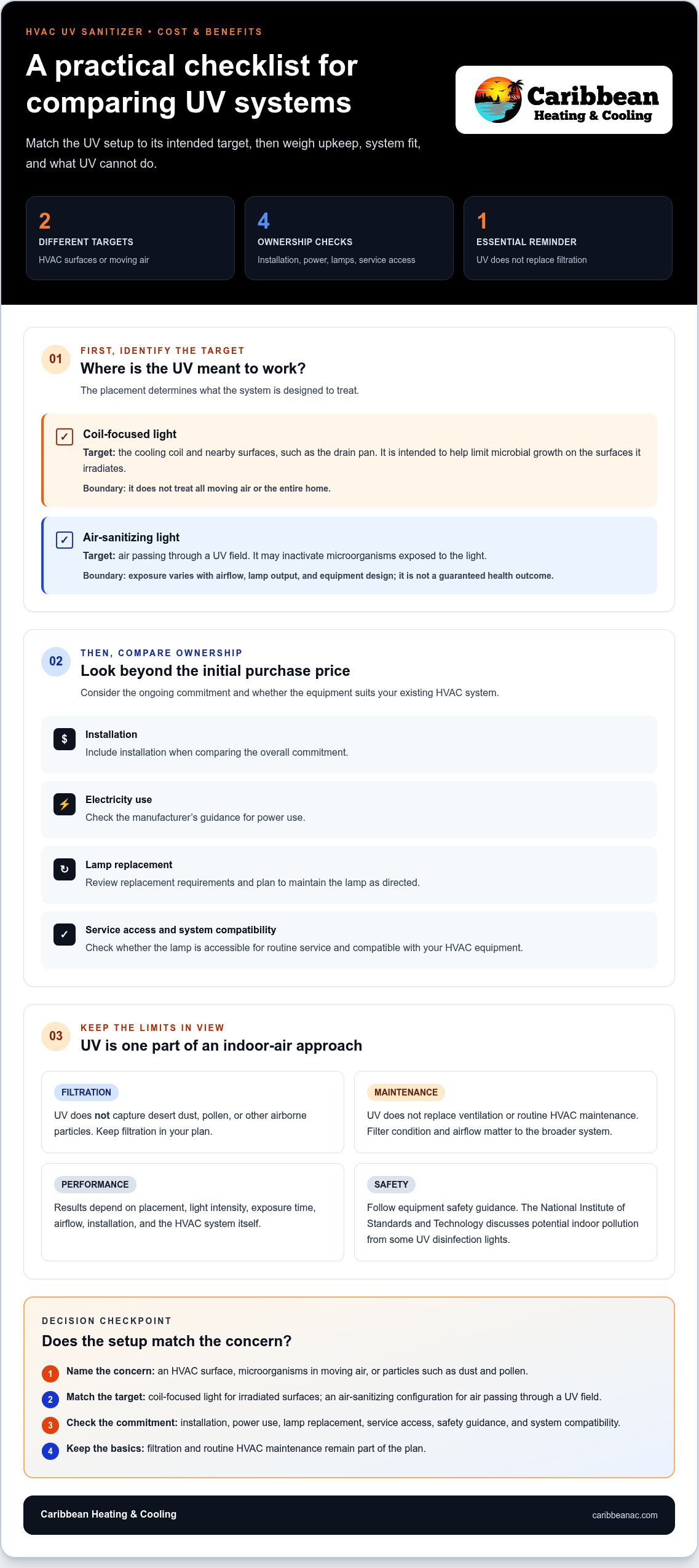
When comparing UV light air sanitizer for HVAC cost and benefits, the first question is where the system is meant to work. A lamp aimed at an HVAC coil has a different purpose from a unit designed to expose moving air to UV light. Matching the setup to your concern helps you judge whether its upkeep and potential benefits make sense for your home.
Neither type replaces filtration for dust, pollen, or other particles. Performance also depends on placement, exposure, and the HVAC system itself. This guide explains what each setup is designed to do, what to consider when comparing ownership costs, and how to make a practical decision. For homeowners in Las Vegas, Henderson, Summerlin, and North Las Vegas, it also outlines how to connect an indoor-air concern with the right next step.
Key Takeaways
- Identify whether a UV system is intended to treat HVAC surfaces or moving air, then match its purpose to your concern.
- Compare UV light air sanitizer for HVAC cost and benefits by considering installation, lamp replacement, electricity use, and access for service.
- Keep filtration in your plan: UV light doesn’t capture desert dust, pollen, or other airborne particles.
- Consider your home’s air-quality goals and HVAC condition before deciding whether professional indoor-air-quality support is a sensible next step.
What Does an HVAC UV Light Air Sanitizer Treat, and What Can It Not Do?
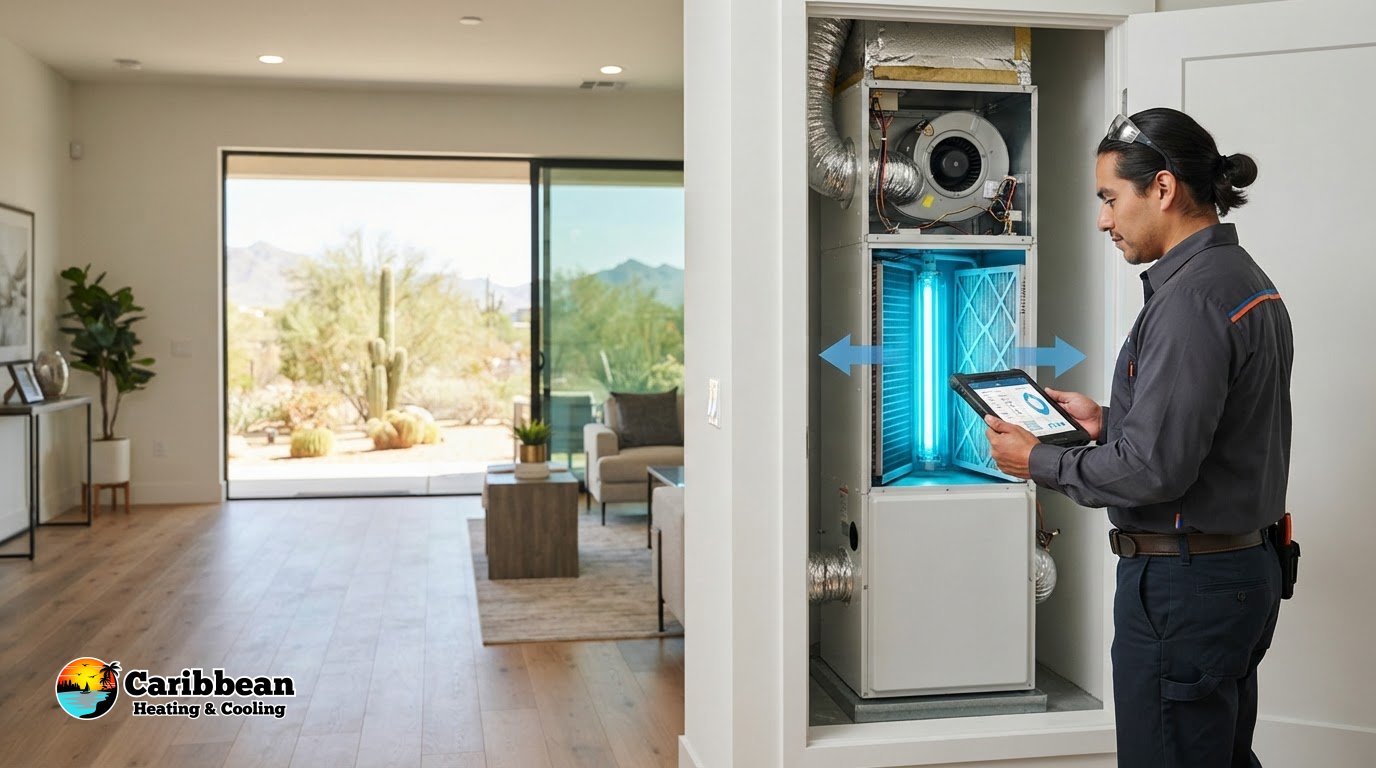
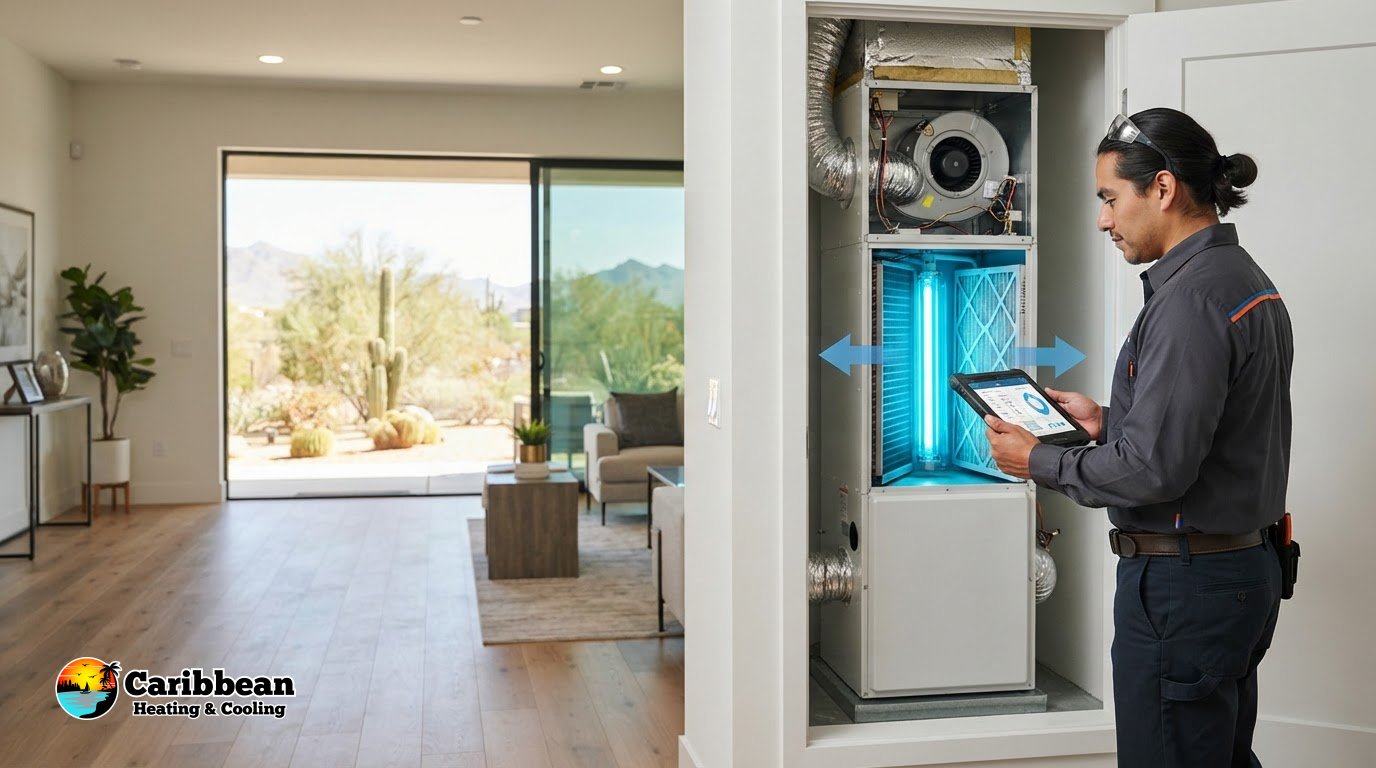
An HVAC UV sanitizer uses ultraviolet light in a specific part of a heating and cooling system. Its intended target depends on placement. A lamp aimed at a coil treats that surface, while an air-sanitizing setup exposes moving air as it passes through a UV field. “Whole-home” should not be taken to mean that every surface or particle in the home receives treatment.
Ultraviolet germicidal irradiation (UVGI) describes the use of UV to inactivate microorganisms. In an HVAC system, results depend on factors such as light intensity, exposure time, airflow, and installation. Evaluate claims in relation to the specific setup and its intended target, rather than relying on the product label alone.
Coil lights versus air-sanitizing lights: where does the UV reach?
A coil-focused light is positioned to shine on a stationary surface, commonly the cooling coil and nearby areas such as the drain pan. Its purpose is to limit microbial growth on the surfaces it irradiates. It does not disinfect the entire home or capture material circulating through the HVAC system.
An air-sanitizing configuration is positioned so air passes through a UV field. The exposure depends on factors such as airflow, lamp output, and equipment design. UV may not reach every part of a moving air stream equally, so results vary with the system and installation. It should not be treated as a guaranteed health outcome.
UV equipment is not a substitute for filtration, ventilation, or routine HVAC maintenance. It does not capture desert dust, pollen, or other particles, and it does not address every indoor pollutant. When weighing UV light air sanitizer for HVAC cost and benefits, first identify the concern and whether it involves an HVAC surface or microorganisms in moving air. Then consider UV as one possible part of a broader indoor-air-quality approach.
How to Compare HVAC UV Sanitizer Costs, Benefits, and Limitations
Compare systems by their intended target and ongoing ownership needs, not just the initial purchase price. Installation, electricity use, lamp replacement, and access for maintenance all affect the overall commitment. The right balance depends on what you want treated and how the system fits your existing HVAC equipment.
| Setup | Intended target | Potential role | Upkeep and limits |
|---|---|---|---|
| Coil-focused light | Coil and nearby surfaces | Helps limit microbial growth on irradiated surfaces | Requires lamp upkeep and service access; doesn’t treat all moving air |
| Air-sanitizing light | Air passing through a UV field | May inactivate microorganisms exposed to the light | Exposure depends on airflow and design; doesn’t capture particles |
Before choosing a setup, review the manufacturer’s guidance for lamp replacement, power use, safety precautions, and compatibility with your system. Consider whether the lamp will be accessible for routine service and whether its position matches its stated purpose. These checks make it easier to compare systems based on how they will be used, not just their advertised benefits.
Which questions help determine whether the investment fits your home?
Start with a clear goal: are you concerned about a surface inside the HVAC equipment or microorganisms in circulating air? Next, consider the lamp’s replacement requirements and whether you can maintain it as directed. Keep filtration and routine HVAC maintenance in the plan because UV does not remove dust or pollen. The National Institute of Standards and Technology discusses potential indoor pollution from some UV disinfection lights in UV Disinfection Lights Can Cause Indoor Air Pollution, so follow the equipment’s safety guidance closely.
A practical comparison of UV light air sanitizer for HVAC cost and benefits begins with a specific indoor-air goal and a realistic upkeep plan. Caribbean Heating & Cooling provides residential indoor-air-quality solutions and HVAC services for homeowners in Las Vegas, Henderson, Summerlin, North Las Vegas, and surrounding areas. These services can help address indoor-air needs alongside the condition and maintenance of your home’s heating and cooling system.
Is an HVAC UV Air Sanitizer a Good Fit for Las Vegas Homes?
Begin with the problem you want to solve. Dust can be a noticeable indoor-air concern in the Las Vegas area, but a UV light does not capture or remove dust. Filtration is the part of the system that captures particles. UV may be worth considering only when your concern matches what a particular setup is designed to treat, such as microbial growth on an HVAC surface or microorganisms passing through an air-sanitizing unit.
Consider the condition of the whole system before adding equipment. A clogged or poorly maintained filter, airflow problems, or an HVAC system that needs attention can affect comfort and air quality regardless of UV. Keep filtration and routine maintenance in your plan, then decide whether UV addresses a separate, specific concern. This makes the UV light air sanitizer for HVAC cost and benefits decision more practical than choosing equipment based on broad promises.
A practical next step for indoor air quality in the Las Vegas area
Write down what you have noticed, such as dust buildup, odors, or concerns about the HVAC equipment. Note your current filter and system setup, too. This gives you a clearer starting point when considering indoor-air-quality solutions. Caribbean Heating & Cooling provides residential indoor-air-quality services in Las Vegas, Henderson, Summerlin, North Las Vegas, and surrounding areas.
Caribbean Heating & Cooling can help homeowners consider indoor-air-quality needs alongside HVAC maintenance and system condition. A focused review can help you prioritize an appropriate approach without treating UV as a replacement for filtration or maintenance.
Make Your Next Indoor-Air Decision With Confidence
Clarify what you want to improve before investing in another component. Looking at your home’s indoor-air concerns alongside its HVAC setup can help you decide where to focus, whether that means filtration, system maintenance, or another indoor-air-quality measure. The right approach should fit your home and the specific problem you are trying to address.
Caribbean Heating & Cooling provides residential indoor-air-quality support in Las Vegas, Henderson, Summerlin, North Las Vegas, and surrounding areas. Its licensed, bonded, insured, and certified HVAC technicians provide residential HVAC services, with transparent, upfront pricing and no hidden fees. For help with your home’s indoor-air-quality needs, explore Caribbean Heating & Cooling’s residential indoor-air-quality services.
Frequently Asked Questions
Can an HVAC UV light replace my air filter?
No. UV equipment and air filters do different jobs. A filter traps particles as air moves through the system, while a UV lamp does not catch them. Keep using the filter type and replacement schedule specified for your HVAC equipment. UV may complement filtration only when its intended target and placement suit your system and indoor-air needs.
How often should an HVAC UV lamp be replaced?
Follow the instructions for the specific lamp because there is no universal replacement interval. For a fair UV light air sanitizer for HVAC cost and benefits comparison, include the replacement schedule and the effort needed to access the lamp. Keep the model information and installation paperwork, then record each replacement date so upkeep does not rely on memory.
Do HVAC UV lights produce ozone?
It depends on the UV technology and wavelength, so do not assume every device is ozone-free. Review the product’s technical documentation for its stated ozone characteristics before deciding. If that information is unclear, treat it as an unresolved consideration rather than assuming the equipment is suitable. Follow the manufacturer’s installation and operating instructions for the specific unit.
Will an HVAC UV sanitizer remove dust from my Las Vegas home?
No. UV equipment is not designed to capture dust, so it will not replace filtration for that concern. In a Las Vegas home, consider whether the installed filter is appropriate for your HVAC system and whether dust is accumulating around supply areas or on household surfaces. Those observations can help clarify whether filtration or another home-specific factor deserves attention.

Related Posts
Comments (0)