
La marca con la calificación más alta no siempre es, de forma automática, la mejor opción para su hogar en Las Vegas. Las calificaciones pueden...
Most Energy Efficient Air Conditioner in Las Vegas: Which Type Fits Your Home
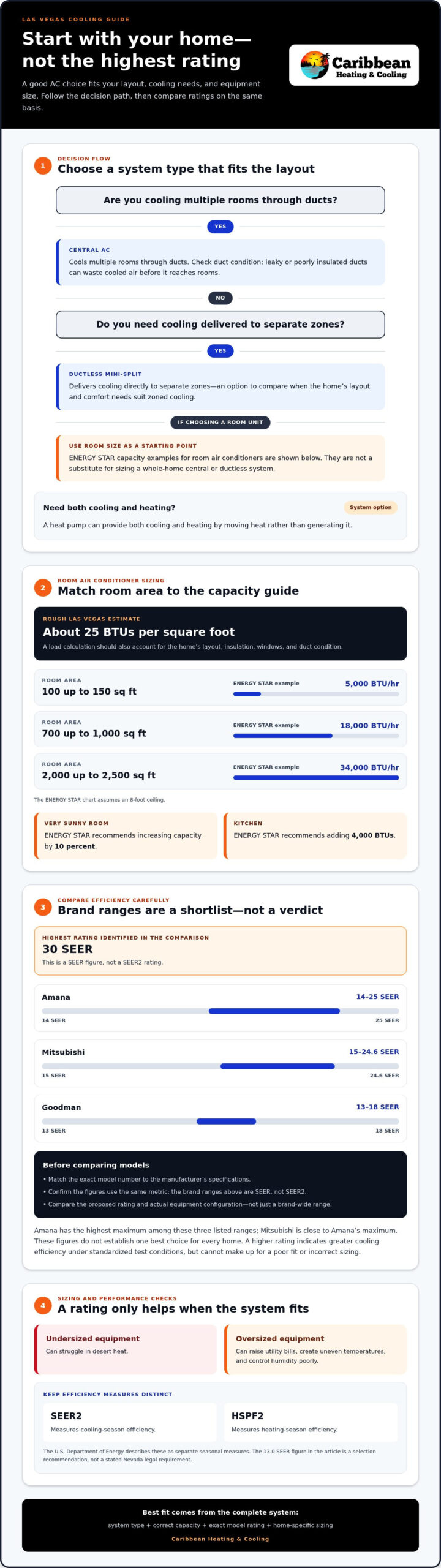
The highest-rated brand isn’t automatically the best fit for your Las Vegas home. Ratings reach as high as 30 SEER, but the most energy-efficient air conditioner in Las Vegas for your household depends on the system type and how well it suits your space. Listed brand ranges vary: Amana spans 14 to 25 SEER, Mitsubishi 15 to 24.6 SEER, and Goodman 13 to 18 SEER.
When comparing the most energy efficient air conditioner in Las Vegas, brand ratings are only one part of the decision. Central and ductless systems suit different home layouts and comfort needs. This guide explains how system types compare, what efficiency ratings can tell you, and why choosing the right fit matters for reliable cooling in Las Vegas heat.
Key Takeaways
- Compare central and ductless systems against your home’s layout and comfort needs to narrow down the right type.
- Use room size and ENERGY STAR capacity guidance as a starting point when considering room air conditioning.
- Look beyond brand names: compare efficiency ranges and weigh system fit alongside the rating.
- Turn to Caribbean Heating & Cooling for AC repair when your system isn’t cooling reliably, or for AC installation and maintenance when planning a replacement or ongoing care.
Central and ductless air conditioning
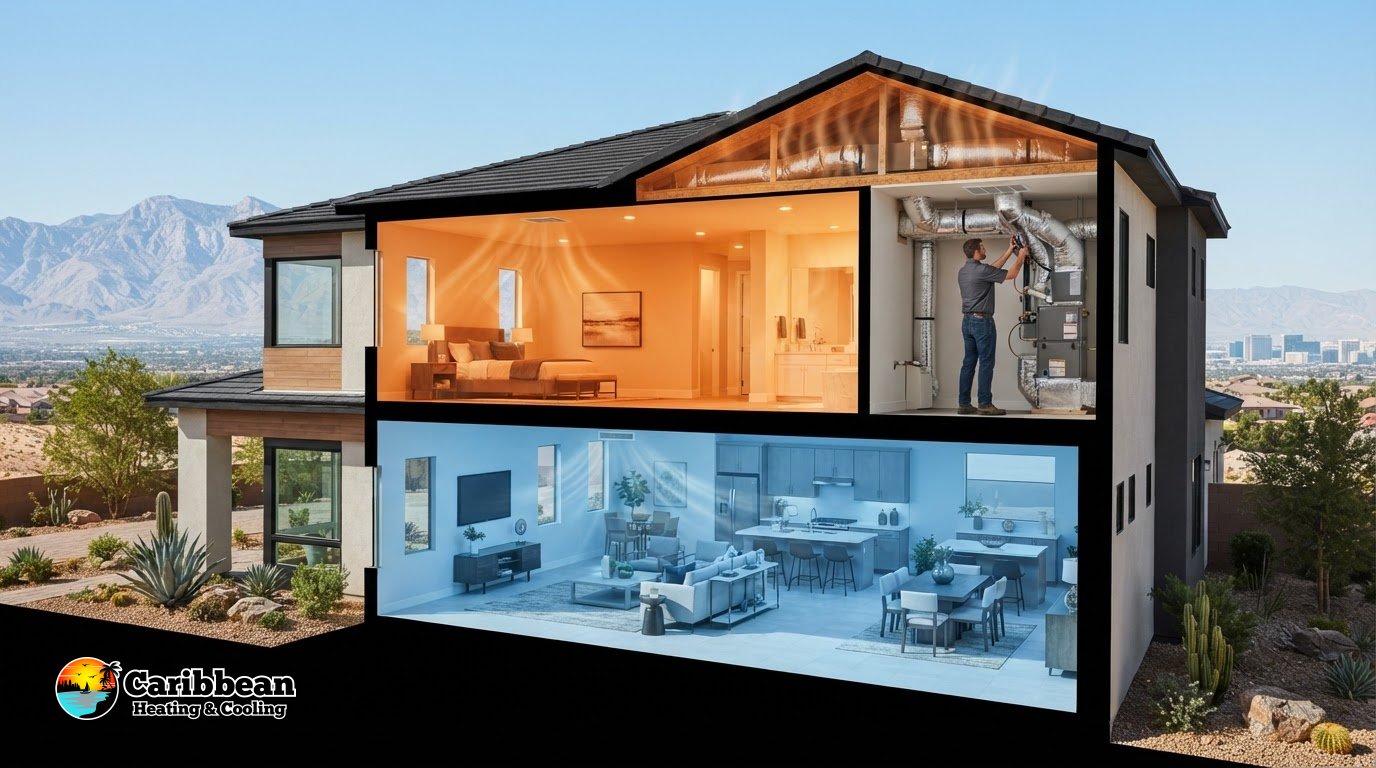
The most energy-efficient air conditioner in Las Vegas depends on the home, not just the system category. Central AC cools multiple rooms through ducts, while ductless mini-splits deliver cooling directly to separate zones. A heat pump can provide both cooling and heating by moving heat rather than generating it. The U.S. Department of Energy says SEER2 measures cooling-season efficiency, while HSPF2 measures heating-season efficiency.
The 13.0 SEER figure is a selection recommendation, not a stated Nevada legal requirement. For efficient operation, compare equipment ratings and match system capacity to the home’s cooling load.
For a visual explanation of how air conditioners move heat, watch this video:
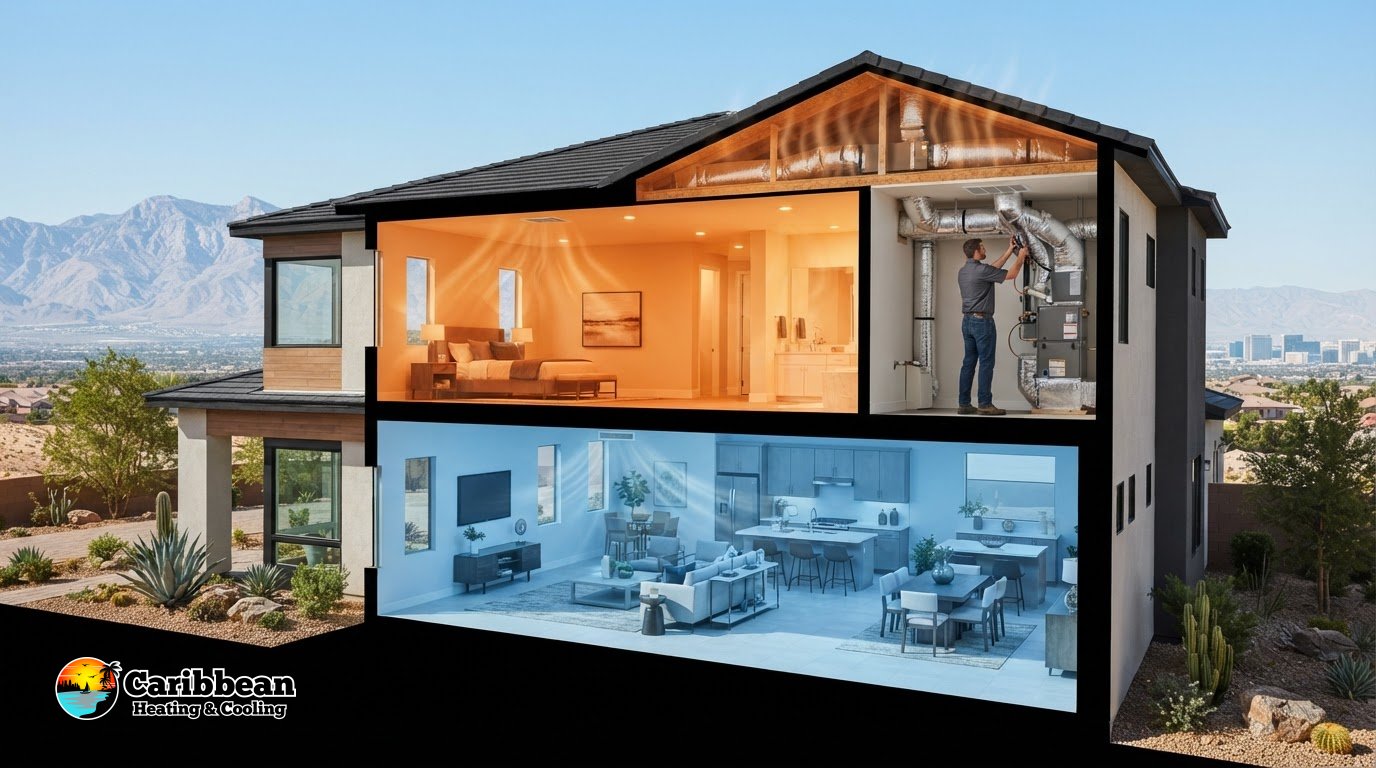
Size matters. A rough Las Vegas estimate is about 25 BTUs per square foot, but a load calculation should account for the home’s layout, insulation, windows, and duct condition. Undersized equipment can struggle in desert heat; oversized equipment can raise utility bills, create uneven temperatures, and control humidity poorly. Leaky or poorly insulated ducts also waste cooled air before it reaches rooms.
For room air conditioners, ENERGY STAR pairs rooms of 100 up to 150 square feet with a 5,000 BTU-per-hour unit, 700 up to 1,000 square feet with an 18,000 BTU-per-hour unit, and 2,000 up to 2,500 square feet with a 34,000 BTU-per-hour unit. ENERGY STAR’s chart assumes an 8-foot ceiling. For a very sunny room, ENERGY STAR recommends increasing capacity by 10 percent; for a kitchen, it recommends adding 4,000 BTUs. These room-unit examples aren’t a substitute for sizing a whole-home central or ductless system.
AC brand efficiency ranges
Brand ranges help narrow the search, but they don’t identify one winner for every Las Vegas home. Amana air conditioners are listed from 14 to 25 SEER, Mitsubishi from 15 to 24.6 SEER, and Goodman from 13 to 18 SEER. These figures describe ranges, not the efficiency of every model a brand sells.
Compare the exact model, not just the logo. A brand’s top rating may apply to a particular system configuration, while other models in its range have lower ratings. Also keep the rating metric consistent: the figures above are SEER, so don’t treat them as SEER2 values. Compare ratings on the same basis before weighing equipment options.
To compare models and verify efficiency claims, match each model number to the manufacturer’s specifications and check that the efficiency figures use the same rating metric. Compare the proposed system’s rating and actual equipment configuration, rather than relying on a brand-wide range.
A higher rating can indicate greater cooling efficiency under standardized test conditions, but it doesn’t determine the best choice for your home. Las Vegas heat, your home’s cooling load, and correct equipment sizing all affect real-world performance. A strong rating cannot make up for a poor fit.
Use the ranges as a shortlist, then compare specific options against your home’s needs. A home-focused review of cooling system options can help put rating differences in context before choosing.
Which air conditioner models have the highest SEER2 ratings for Las Vegas homes?
The highest rating identified in the available comparison is 30 SEER. Treat that as a SEER figure, not a SEER2 rating. The listed brand ranges also use SEER: Amana spans 14 to 25, Mitsubishi spans 15 to 24.6, and Goodman spans 13 to 18. These ranges show variation within each brand, not the rating of every model.
For a useful comparison, match the exact model numbers and compare systems using the same efficiency metric. Don’t assume a brand’s highest number applies to every unit in its lineup. The U.S. Department of Energy describes SEER2 as a measure of cooling-season efficiency, so check whether each model’s published figure is SEER or SEER2 before comparing.
- Amana: Its listed range reaches 25 SEER, making it the highest maximum among these three brand ranges.
- Mitsubishi: Its listed range reaches 24.6 SEER, close to Amana’s maximum.
- Goodman: Its listed range reaches 18 SEER, with a lower maximum than the other two ranges.
These figures don’t establish one best choice for every Las Vegas home. Compare the specific unit’s rating and system type with your home’s cooling needs. A high rating is useful, but correct sizing and installation also matter. Focus on the complete system, not brand reputation alone.
Ready to plan a replacement? Explore AC installation options for your home.
Caribbean Heating & Cooling: AC Repair
Caribbean Heating & Cooling can help when your air conditioner stops cooling reliably, struggles to maintain comfort, or needs attention before you consider replacement. AC Repair addresses system problems, while AC Maintenance provides routine care. If an older unit no longer meets your needs, AC Installation can help you choose a better-fitting system. The right next step depends on whether your equipment needs repair, maintenance, or replacement.
Choosing an efficient model is only part of dependable home comfort. Keeping your system in working order can help you get practical value from that choice through Las Vegas’s demanding cooling season. For help with an AC problem or system upgrade in Las Vegas, Henderson, Summerlin, or North Las Vegas, contact Caribbean Heating & Cooling.
Make Your Next Cooling Decision With Confidence
Choosing the most energy-efficient air conditioner in Las Vegas is a practical step toward dependable comfort, but your current system still needs to meet your home’s needs. Persistent cooling problems may call for repair; an aging or poorly matched unit may be better suited to replacement. Regular maintenance can also help keep an existing system operating as intended.
Caribbean Heating & Cooling offers AC Repair, AC Installation, and AC Maintenance for these different needs. If you’re unsure whether to repair or replace your system, discussing its condition and your home’s comfort concerns can help clarify the next step.
Contact Caribbean Heating & Cooling to discuss your AC needs. A well-considered next step can help you feel more prepared for the heat ahead.
Frequently Asked Questions
Which AC brand is the best?
No single AC brand is best for every Las Vegas home. Compare specific models with your home’s cooling needs, system type, and installation requirements instead of relying on brand reputation alone. A model with a strong efficiency rating may still be a poor fit if its capacity or configuration doesn’t suit your home.
How do SEER2 and EER2 ratings affect air conditioner efficiency in Las Vegas heat?
SEER2 measures cooling efficiency across a season, while EER2 indicates efficiency under specific operating conditions. Use SEER2 to compare seasonal performance and EER2 to assess performance at a particular condition, including hot-weather operation. Compare like with like: ratings using different metrics don’t provide a direct comparison, and neither rating alone determines your home’s electricity use.
How much do high-efficiency air conditioners cost to buy and install in Las Vegas?
The price depends on the case and is given after a quote request. Key factors include the system type, required capacity, equipment configuration, and installation complexity. Whether the project involves central or ductless equipment can also affect the scope. Compare the proposed system and installation details together, since equipment selection is only one part of the total project.
How much can a high-efficiency AC save on summer electricity bills in Las Vegas?
Estimate potential savings by comparing the old and new systems’ electricity use under similar cooling conditions, then applying your utility rate. The result depends on the existing unit’s efficiency, how often the AC runs, thermostat settings, and how well the new system is sized and installed. Your bills and equipment records provide a more useful comparison than a general savings claim.
What are Nevada’s current efficiency requirements for residential air conditioners?
The 13.0 SEER figure is a selection recommendation, not a stated Nevada legal requirement.

Related Posts
Comments (0)