
El costo de instalación de una bomba de calor en North Las Vegas depende del tipo y la capacidad del sistema, los ductos y la instalación eléctrica...
Clark County Residential HVAC Permit Requirements: Homeowner Guide
A Clark County HVAC replacement requires a permit, and other regulated mechanical work may need one too. A residential HVAC permit in Clark County is required for regulated work to install, enlarge, alter, repair, move, convert, or replace a mechanical system. The property’s address matters, so confirm which jurisdiction oversees it before planning the permit steps.
Permit requirements can vary across the valley because they depend on the property’s jurisdiction and the work involved. This guide explains how to identify the right jurisdiction, find permit records, and understand the steps for residential HVAC work, helping you plan with confidence and avoid surprises.
Key Takeaways
- Use the Property Information Center’s Permits tab to locate permit records and review their status.
- Identify the property’s jurisdiction before choosing the right permit process; county and local requirements may differ.
- Understand how the work and permit scope affect the fees you may need to budget for.
- For an AC problem or replacement, learn when Caribbean Heating & Cooling’s repair or installation services can support your next step.
Finding permit records by property
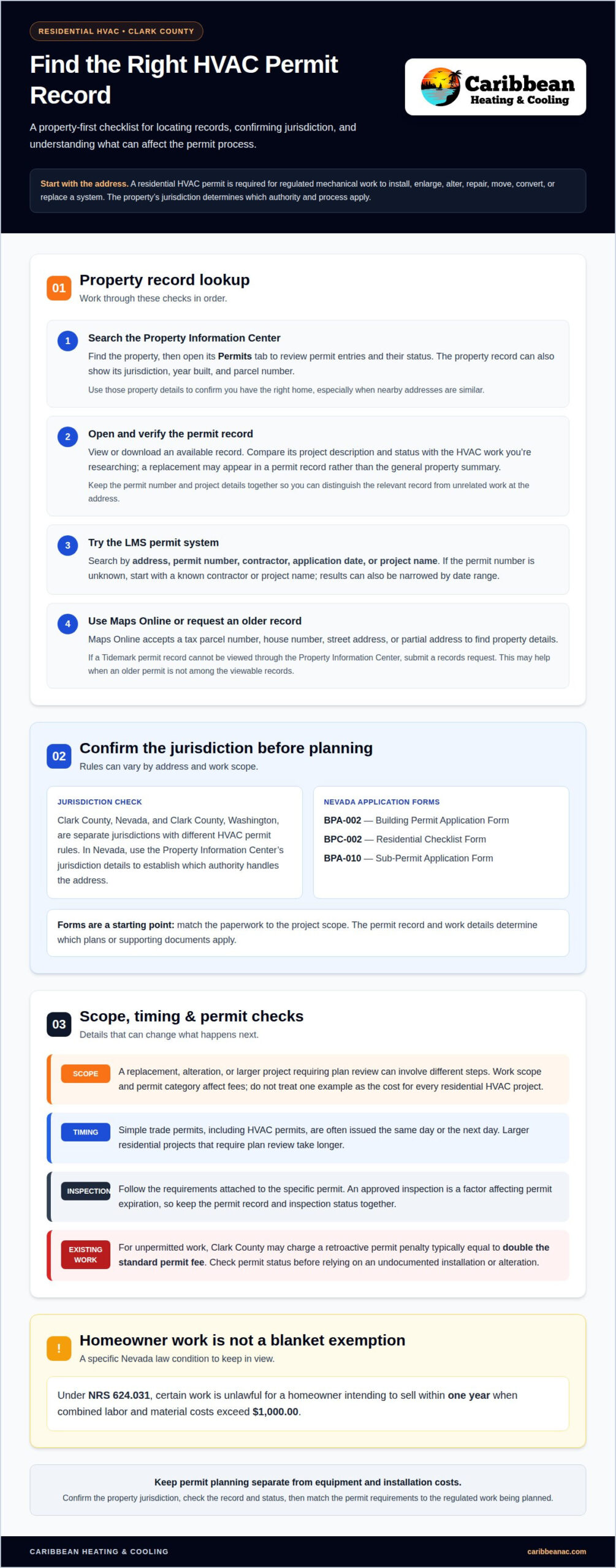
- Start at the Clark County Property Information Center and search for the property. Open the Permits tab to review permit records and their status. The property record can also show its jurisdiction, year built, and parcel number. Use these details to confirm you have the right home, especially when nearby properties have similar street addresses.
- Open any permit record available to view or download. Compare its project description and status with the HVAC work you’re researching. For example, a replacement may appear in a permit record rather than the general property summary. Keep the permit number and project details together to distinguish the relevant record from unrelated work at the address.
- Try Clark County’s LMS permit system if you need another way to find a record. Search by address, permit number, contractor, application date, or project name. If you know the contractor or project name but not the permit number, start with that detail. You can also narrow results by date range.
- Use Maps Online to find property details before searching permit records. Search by tax parcel number, house number, or street address; partial addresses are accepted. If a Tidemark permit record cannot be viewed through the Property Information Center, submit a records request to access it. This can help when an older permit isn’t among the viewable records.
Use the Clark County Property Information Center to check both property details and permit entries. The jurisdiction, year built, and parcel number can help you identify the right property, while the Permits tab shows permit records and their status. When a Clark County permit record is linked, open the viewing or download option to inspect it. Maps Online also accepts partial addresses, tax parcel numbers, house numbers, and street addresses.
Clark County permit jurisdictions
- First, identify the property’s jurisdiction. Clark County, Nevada, and Clark County, Washington, are separate jurisdictions with different HVAC permit rules. In Nevada, check the Property Information Center’s jurisdiction details to establish which authority handles the address.
- To apply in Clark County, Nevada, match the project to the county’s listed forms. These include the Building Permit Application Form, BPA-002, the Residential Checklist Form, BPC-002, and the Sub-Permit Application Form, BPA-010.
- Use the listed application forms as a starting point, then match the paperwork to the project scope. Clark County lists residential application and checklist forms, but the permit record and work details determine which plans or supporting documents apply.
- A homeowner’s ability to perform work is not a blanket permit exemption. Nevada law, NRS624.031, makes certain work unlawful for a homeowner intending to sell within one year when combined labor and material costs exceed $1,000.00.
- For inspections, follow the requirements attached to the specific permit. Clark County’s permit rules recognize an approved inspection as a factor affecting permit expiration, so keep the permit record and inspection status together.
- Simple trade permits, including HVAC permits, are often issued the same day or the next day. Larger residential projects that require plan review take longer, so the work scope affects the approval timeline.
- Clark County adopted the 2024 code edition, effective January 11, 2026. That edition governs applicable code requirements; the project and equipment details determine which provisions apply to residential HVAC work.
- For unpermitted work, Clark County may charge a retroactive permit penalty typically equal to double the standard permit fee. Check the permit status before relying on an undocumented installation or alteration.
The valley’s jurisdictions adopted the 2024 code edition in July 2025. The Clark County Property Information Center provides property jurisdiction, permit information, year built, and parcel number details.
What are the current Clark County residential HVAC permit fees?
- This figure covers the permit, not the equipment or installation work. Keep those costs separate when planning a replacement so the county fee isn’t confused with the project estimate.
- The broader range covers different residential permit types and project scopes. It isn’t a separate HVAC replacement charge; use the HVAC-specific range when estimating a straightforward replacement permit.
- Define the project before budgeting. A replacement, an alteration, or a larger project requiring plan review can involve different application steps. The scope of work and permit category affect the fee, so don’t treat one example as the cost for every residential HVAC project.
- Separate permit costs from HVAC service costs in your planning. The permit fee relates to county review and authorization, while equipment and installation are separate project expenses. For help planning the home comfort work itself, get HVAC project support before scheduling a replacement.
Caribbean Heating & Cooling: AC Repair
Caribbean Heating & Cooling provides AC Repair when a home cooling system stops working or struggles to keep rooms comfortable. If an inspection points to replacement rather than repair, AC Installation may be the appropriate next step. AC Maintenance can help keep the system in good condition before cooling problems interrupt home comfort.
Keep permit planning separate from equipment diagnosis. For regulated mechanical work, confirm the applicable permit requirements before work begins. Then plan the HVAC service around the system’s needs and the project scope. For heating concerns, Caribbean Heating & Cooling also provides Heating Repair.
Contact Caribbean Heating & Cooling or visit caribbeanac.com to discuss your home comfort needs.
Plan the next step with confidence
Once permit planning is clear, consider your home’s comfort needs. A residential HVAC permit in Clark County is one part of a project; deciding whether your system needs attention is another. Note ongoing cooling trouble, changes in performance, or signs that replacement may be needed. Those details can help clarify what work makes sense for your home.
Caribbean Heating & Cooling offers AC Repair, AC Installation, and AC Maintenance for homeowners addressing system issues or planning equipment work. Choose the service that fits your situation, and keep permit planning aligned with the project scope.
Explore HVAC service options and take a practical next step toward dependable home comfort.
Frequently Asked Questions
When Do You Need a Permit?
You need a permit before starting regulated mechanical work on a residential HVAC system in Clark County, Nevada. This can include projects that change the system’s configuration, not just a full replacement. If it’s unclear whether the proposed work requires a permit, contact the Clark County Department of Building & Fire Prevention before work begins and describe the specific change.
Does Clark County require a permit for residential HVAC installation or replacement?
Yes. HVAC replacement in Clark County requires a permit, as does regulated mechanical system installation. Replacing an existing system isn’t automatically exempt just because the new equipment serves the same home. Include permit planning in the project from the start, rather than waiting until installation is underway.
Which Clark County agency issues residential HVAC permits?
The Clark County Department of Building & Fire Prevention handles county residential HVAC permit requirements. Contact the department to ask whether a project needs a permit before work starts. First confirm that the home falls within Clark County’s jurisdiction, since the responsible authority depends on the property’s location.
What residential HVAC work requires a permit in Clark County?
A permit is required for regulated work to install, enlarge, alter, repair, move, convert, or replace a mechanical system. The scope matters: a repair that changes regulated system components may be treated differently from routine upkeep. When determining whether a permit applies, describe the specific work, such as relocating equipment or altering the system.
What HVAC codes and equipment efficiency requirements apply in Clark County?
Clark County adopted the 2024 code edition, effective January 11, 2026; the project and equipment details determine which provisions apply.

Related Posts
Comments (0)