
Al comparar los costos y beneficios del purificador de aire con luz UV para HVAC, la primera pregunta es en qué parte del sistema debe actuar. Una...

Risks of an Oversized Air Conditioner in a Dry Climate
What if the air conditioner that cools your Las Vegas home fastest is also making comfort and energy use worse? Dry desert air can make poor humidity removal less noticeable, but it doesn’t eliminate the risks of an oversized air conditioner in a dry climate. A system that cools the area near the thermostat too quickly may shut off before conditioned air reaches every room, then start again soon after.
Uneven temperatures and frequent cycling can point to a sizing issue, but they can also have other causes. This article explains the possible effects of oversizing, including wasted energy, added equipment wear, hot and cool spots, and reduced air circulation. It also covers what to track before an assessment and how to weigh repair, adjustment, or replacement without assuming a new system is automatically needed.
Key Takeaways
- The risks of an oversized air conditioner in a dry climate aren’t limited to humidity. Cooling capacity needs to match your home’s calculated needs.
- Frequent starts and stops or uneven temperatures can signal a sizing issue, but thermostat, airflow, or equipment problems can cause similar symptoms.
- Track when and where comfort problems occur so a technician can consider the pattern alongside the system’s condition.
- Before deciding on a replacement, review the equipment and your home’s cooling load, not just square footage or the previous unit’s size.
Risks of an Oversized Air Conditioner in a Dry Climate: What Changes?
An air conditioner is oversized when its cooling capacity exceeds the home’s calculated cooling load, or the amount of heat the system needs to remove under expected conditions. A large capacity label alone doesn’t prove a mismatch. What matters is whether the equipment suits the house. If the system cools the area around the thermostat quickly and shuts off before other rooms catch up, it may start and stop more often. This pattern is called short cycling.
Dry outdoor air can reduce the work involved in removing moisture, but it doesn’t eliminate the need to size for heat. That distinction matters in Las Vegas, where intense sun and long cooling demands make system performance important for comfort and energy use. The same principle applies in Henderson, North Las Vegas, and Summerlin, though each home’s exposure and construction affect its cooling needs.
For a general overview of how cooling and humidity control work, see Air Conditioning Principles. This video also explains why choosing a larger unit isn’t automatically better:
Why dry desert air does not cancel out oversizing
An AC removes sensible heat, which raises air temperature, and latent heat, which is tied to moisture. In a sunny room, for example, the system has to remove heat absorbed by walls and furniture. In a humid home, it also has to remove more moisture from the air. Las Vegas’s dry air can make that second task less demanding, but the first still matters. The risks of an oversized air conditioner in a dry climate can include short cycling and uneven cooling even when humidity isn’t the main concern.
Cooling load depends on more than the desert forecast or a home’s square footage. Sun exposure, insulation, window size and orientation, and the number of people in the home all influence how much heat enters or is generated indoors. Consider these details together when evaluating system size. That helps distinguish a genuine mismatch from a high-capacity unit that suits the home’s particular cooling needs.
Spotting Possible Oversizing Without Jumping to Conclusions
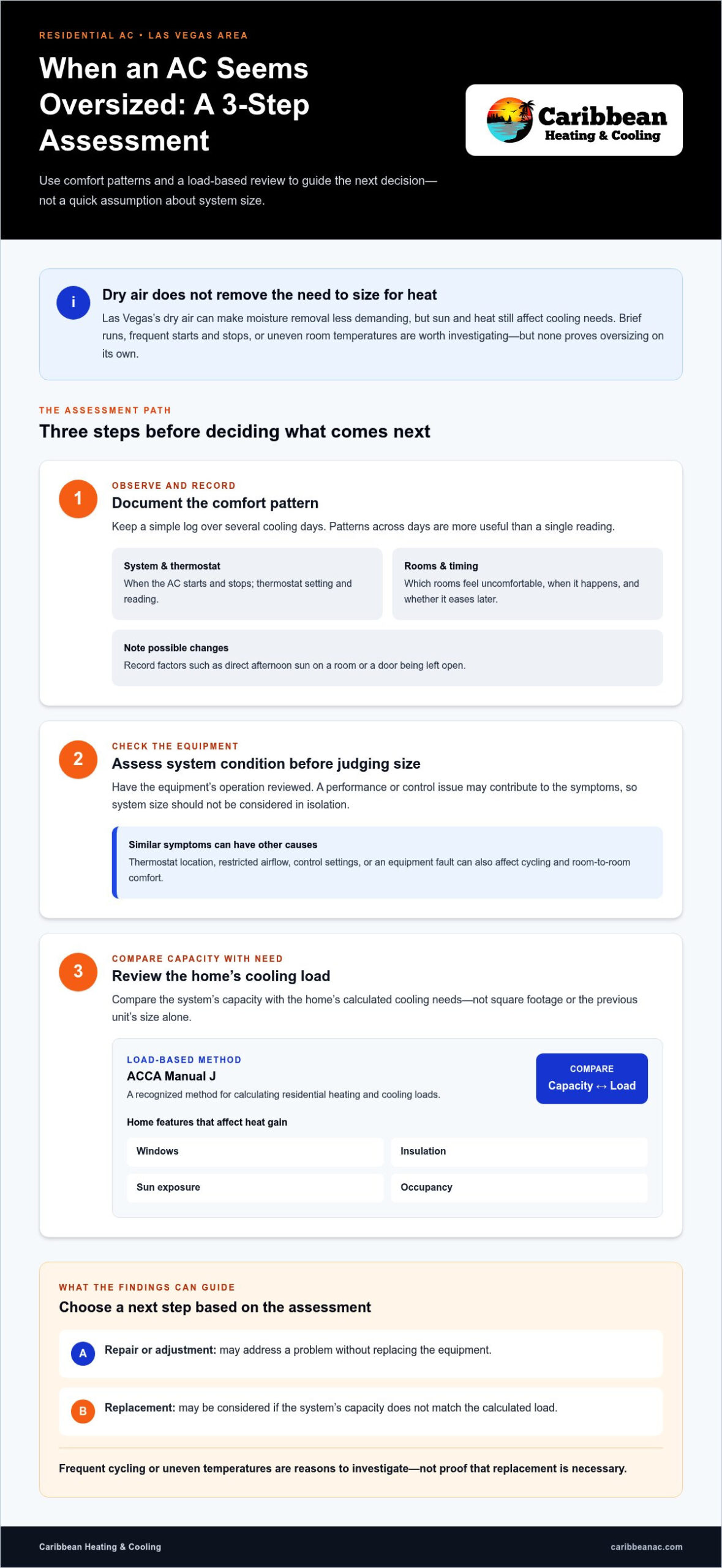
Brief cooling runs, frequent starts and stops, or rooms that stay warmer than the thermostat area are patterns worth investigating. They may appear together, but none confirms a sizing problem by itself. A thermostat in a naturally cool hallway, restricted airflow, control settings, or an equipment fault can also affect system operation and comfort from room to room.
Runtime patterns alone cannot establish whether an AC system is oversized. A useful assessment considers the equipment’s condition and how the home responds, rather than treating one symptom as a diagnosis. This helps homeowners consider the risks of an oversized air conditioner in a dry climate without assuming every comfort issue means the unit is too large.
Which observations are useful before an HVAC assessment?
Keep a simple log over several cooling days. Note when the AC starts and stops, the thermostat’s setting and reading, which rooms feel uncomfortable, and when the symptoms occur. Record changes that could affect comfort, such as direct sun on a room or a door being left open. Patterns across different days are more informative than a single reading.
In Las Vegas, afternoon sun can warm rooms differently depending on window exposure. One warm room on an especially hot afternoon isn’t enough to diagnose oversizing. Note whether the problem repeats, which rooms are affected, and whether it eases later in the day. Share those observations during a residential AC assessment, so system performance and home comfort can be considered together.
What to Do If Your Home’s Air Conditioner Seems Oversized
Don’t assume that a short cycle means you need a larger or smaller unit. Start by recording the patterns you’ve noticed, then have the equipment and the home assessed before making a decision. A review can help identify whether the next step is a repair, an adjustment, or a different system.
- Document symptoms. Record when cooling problems happen, which rooms are affected, the thermostat settings, and how often the system starts and stops. Notes from different days can show whether the pattern changes with outdoor conditions.
- Assess system condition. Have the equipment’s operation reviewed. A performance or control issue may contribute to the symptoms, so don’t judge system size in isolation.
- Review the home’s cooling load. Compare the system’s capacity with the home’s actual cooling needs before considering replacement.
How a load-based assessment supports a sound decision
ACCA Manual J is a recognized method for calculating residential heating and cooling loads. Rather than relying only on square footage or the previous unit’s size, a load-based assessment considers home features that affect heat gain, such as windows, insulation, sun exposure, and occupancy. In Las Vegas, Henderson, North Las Vegas, and Summerlin, these details help clarify whether equipment capacity fits a home’s cooling needs. Heating and cooling specialists such as urbanclimatesolutions.co.uk emphasize that careful system design and load calculations are fundamental to maintaining consistent indoor comfort and preventing excessive wear.
The findings can guide the next step. A repair or system adjustment may address a problem without replacing the equipment. If capacity doesn’t match the calculated load, replacement may be considered. The risks of an oversized air conditioner in a dry climate are a reason to investigate, not proof that replacement is necessary. For residential AC service, schedule residential AC service and use the results to make an informed decision.
Make Your Next AC Decision With Confidence
You don’t have to decide on a replacement based on a few uncomfortable rooms or a system that seems to run unusually. A careful assessment can turn those observations into a practical plan, whether that means addressing a repair, improving system performance, or considering installation. Understanding the risks of an oversized air conditioner in a dry climate is a useful starting point, but the right next step depends on your home and equipment.
Caribbean Heating & Cooling provides residential AC repair, installation, and maintenance in the Las Vegas area, including Henderson, North Las Vegas, and Summerlin. Get guidance focused on your home’s comfort and system needs. Schedule residential AC service to take the next step toward an informed decision.
Frequently Asked Questions
What is a Manual J load calculation?
Manual J is a residential method for estimating how much heating and cooling a home needs. It connects a home’s calculated load to suitable equipment capacity, rather than choosing a system by square footage alone. For homes in Las Vegas, Henderson, North Las Vegas, and Summerlin, the assessment should reflect local outdoor conditions and the individual home’s features.
Can duct problems make an air conditioner seem oversized?
Yes. Duct issues can cause comfort symptoms that overlap with a sizing concern, but they don’t establish that the AC has too much capacity. For example, poorly balanced airflow may leave a bedroom warm while the thermostat area feels comfortable. A technician can evaluate airflow and system operation to help distinguish a distribution problem from an equipment-sizing mismatch.
Can a thermostat setting fix an oversized air conditioner?
No. Changing the setpoint doesn’t reduce the air conditioner’s cooling capacity, so it can’t correct a true size mismatch. Setting the temperature lower may make the system run longer and cool the home further, but it won’t necessarily resolve repeated starts or uneven comfort. The risks of an oversized air conditioner in a dry climate call for evaluating the equipment and controls, not relying on a lower setting.

Related Posts
Comments (0)