
Son las 2:00 a. m. en Anthem y, aunque las estrellas del desierto son hermosas, el aire a 38 grados Fahrenheit (3 °C) que se cuela por sus ventanas...
Best Practices for Caribbean Heating & Cooling: Las Vegas Desert Guide (2026)
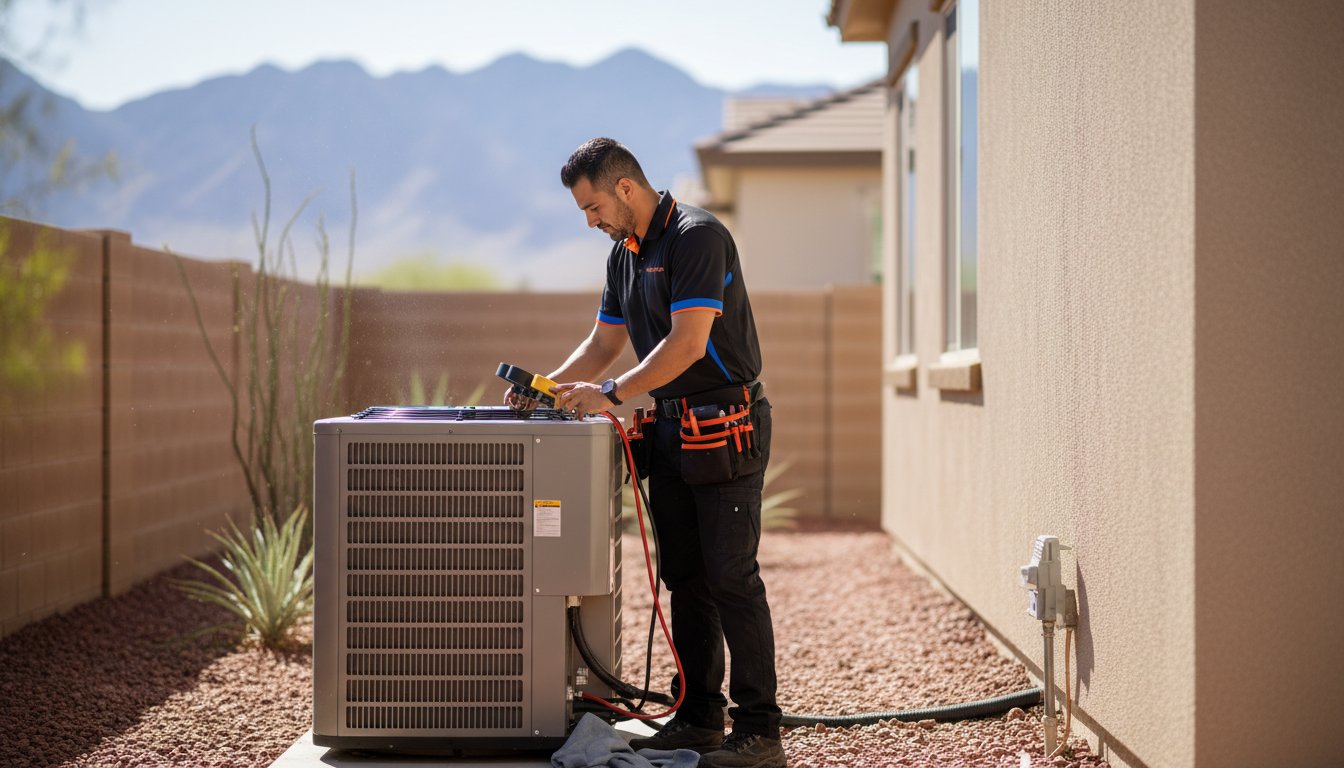
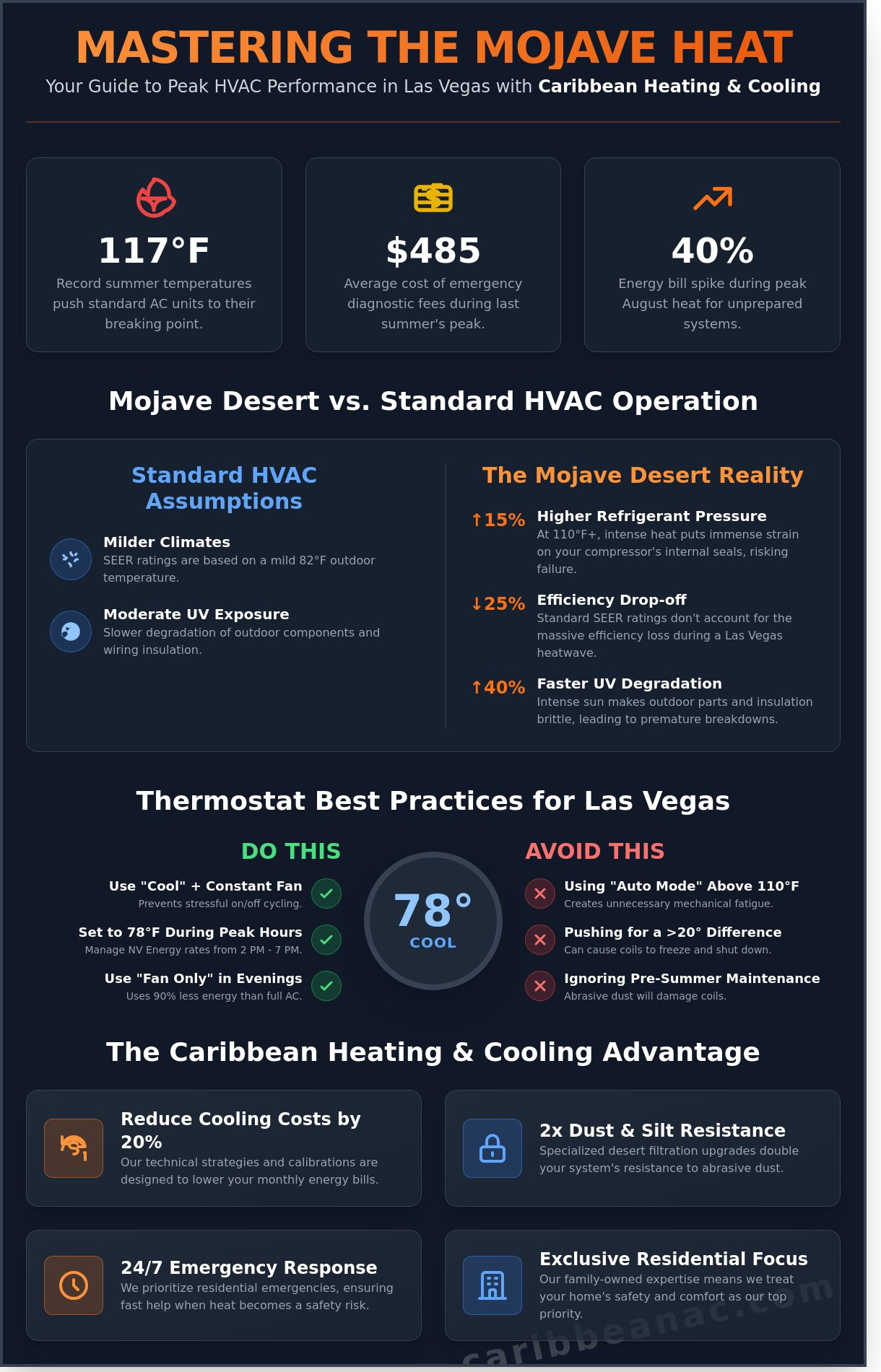
Imagine it’s July 15, 2025, and the Las Vegas strip is baking under a record 117 degree sun. You hear a sudden, metallic grinding sound from your backyard. Within ten minutes, your living room starts climbing toward 90 degrees. This specific scenario cost local homeowners an average of $485 in emergency diagnostic fees last summer alone. Mastering the best practices for Caribbean Heating & Cooling is the most effective way to prevent these cooling catastrophes before they start. Our professional approach transforms your HVAC system from a source of seasonal stress into a reliable shield against the harshest desert elements.
You’ve likely noticed that your energy bills spike by nearly 40% during the peak of August. You’re tired of overpaying for mediocre comfort while dust storms compromise your air quality. We promise to provide the exact technical strategies needed to reduce your monthly cooling costs by 20% while doubling your system’s resistance to heavy silt and dust accumulation. This guide breaks down the essential maintenance milestones, specialized desert filtration upgrades, and calibration secrets you need to ensure peak performance through the 2026 season.
Key Takeaways
- Learn how the Caribbean Heating & Cooling philosophy bridges the gap between tropical comfort and the extreme durability needed for 115-degree desert peaks.
- Discover why common thermostat settings like “Auto Mode” can be a liability during a heatwave and how to correctly configure your unit for maximum relief.
- Master the best practices for Caribbean Heating & Cooling by scheduling critical pre-summer maintenance to shield your outdoor coils from abrasive desert dust.
- Explore actionable ways to reduce the “Heat Island Effect” around your home to lower monthly energy bills and significantly improve indoor air quality.
- Identify why choosing a specialized residential HVAC partner is the most reliable way to ensure long-term comfort and safety for your family in the Vegas Valley.
Why “Caribbean” Expertise Matters for Las Vegas HVAC Systems
Living in the Las Vegas Valley requires more than just a standard air conditioner. The Caribbean Heating & Cooling philosophy merges the high-demand cooling power used in tropical climates with the rugged durability required for the Mojave Desert. While national guidelines suggest bi-annual checks, the 115-degree peaks in July demand a more rigorous approach. You need a system that doesn’t just run; it needs to thrive under extreme thermal stress. Understanding the fundamentals of Heating, ventilation, and air conditioning (HVAC) is the first step toward maintaining a healthy home in Nevada. Following the Best practices for Caribbean Heating & Cooling ensures your equipment handles the transition from 30-degree winter nights to scorching summer afternoons without failure.
The Mojave Desert vs. Standard HVAC Operation
In the desert, dry heat changes the physics of your cooling cycle. When outdoor temperatures exceed 110 degrees, refrigerant pressures can climb 15% higher than the levels seen in milder, more humid regions. This puts immense strain on your compressor’s internal seals. Standard SEER ratings are often calculated at a baseline of 82 degrees Fahrenheit, but these numbers don’t account for the 25% efficiency drop-off that occurs during a Summerlin heatwave. Additionally, the intense UV radiation in Southern Nevada causes outdoor condenser components and wire insulation to become brittle 40% faster than in shaded or cloudy environments. Local expertise is the only way to calibrate a system for these specific stressors.
The Caribbean Heating & Cooling Residential Focus
We focus exclusively on residential properties because homeowners in Henderson and Summerlin can’t afford to wait 48 hours while a technician finishes a massive commercial warehouse project. Our 24/7 emergency response protocol ensures that help arrives when the heat is a safety risk, not just an inconvenience. Family-owned local expertise translates to a higher level of accountability. We treat every home as if our own families lived there, prioritizing long-term durability over quick, temporary fixes. This community-rooted approach is why residents trust us to maintain their comfort during the most demanding months of the year. We provide a safe pair of hands for your home’s most vital infrastructure. Implementing the Best practices for Caribbean Heating & Cooling means your family stays safe even when the grid is pushed to its limits.
Mastering Your AC Modes for the Mojave Desert Heat
Many homeowners assume “Cool Mode” is the only setting they need. While it’s the workhorse of your system, relying on it blindly during a 115-degree July day often leads to extreme inefficiency. Understanding the Best practices for Caribbean Heating & Cooling means knowing how to manipulate your system’s brain to handle extreme heat without skyrocketing your utility bill.
One critical mistake is using “Auto Mode” when temperatures soar above 110 degrees. In this setting, the system can toggle between cooling and heating to maintain a precise temperature. In the Mojave, this creates unnecessary cycling that stresses the compressor and wastes energy. Stick to “Cool” with a constant fan during the hottest hours to prevent mechanical fatigue. If you want to move air without the high costs, “Fan Only” mode is a lifesaver. It uses about 90% less energy than the compressor; this makes it ideal for evening hours when the outside air finally dips below 90 degrees.
Set realistic expectations for your equipment. Most residential units are engineered to provide a 20-degree difference between the outdoor air and your indoor supply. If it’s 115 outside, your AC will struggle to hit 68 degrees. Pushing it that hard causes the coils to freeze and leads to a total system shutdown. Following Critical Maintenance Best Practices ensures your system maintains this 20-degree delta without failing under the desert sun.
Thermostat Best Practices for Las Vegas
During peak-demand hours from 2 PM to 7 PM, NV Energy rates can spike significantly. We recommend setting your thermostat to 78 degrees during this window. Smart thermostats are no longer optional; they’re essential for managing Time-of-Use rates in 2026. These devices can “pre-cool” your home to 72 degrees at 1 PM, allowing the house to coast through the expensive afternoon hours. Frequent “thermostat cranking”, which is dropping the temp to 60 in hopes of cooling faster, doesn’t work. It only keeps the compressor running longer, which accounts for 85% of summer motor burnouts.
Humidity Management in a Dry Climate
In the Cayman Islands, “Dry Mode” is a staple to remove tropical moisture. In Las Vegas, using this mode is usually a mistake. Our indoor humidity often drops below 15%, which can shrink wood flooring and cause respiratory irritation. Integrating a whole-home humidifier helps maintain a healthy 30% to 45% range. This balance protects your home’s infrastructure and makes 78 degrees feel cooler than it actually is. If your system feels like it’s blowing bone-dry air, you might need to schedule a professional calibration to optimize your indoor air quality and ensure your Best practices for Caribbean Heating & Cooling are fully implemented.
Critical Maintenance Best Practices for Henderson and Summerlin Homes
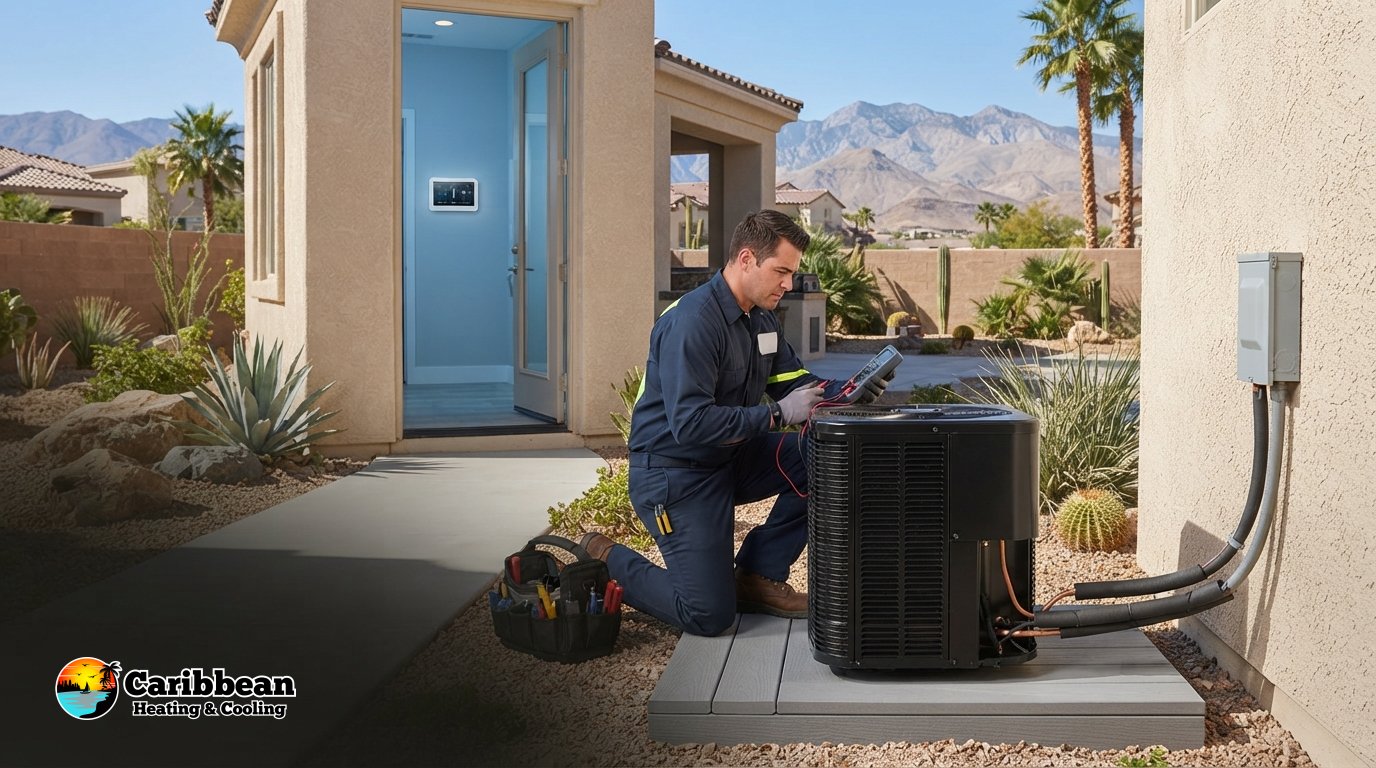
April is the critical deadline for HVAC readiness in the Las Vegas Valley. Once temperatures consistently hit triple digits, your system often runs for 18 hours a day without a break. We recommend scheduling a “Pre-Summer Tune-Up” no later than April 20th. This timing ensures your unit is prepared for the 117-degree peaks recorded in recent Henderson summers. Desert dust and caliche particles act as an insulating blanket on your outdoor condenser coils. This layer of grime forces the compressor to work 25% harder to reject heat into the atmosphere. Best practices for Caribbean Heating & Cooling involve a professional pressurized wash of these coils to prevent high-pressure cutouts and expensive motor burnouts.
Monsoon season introduces another layer of risk to your cooling system. High winds from July through September push sand and organic debris into your unit’s internal components. This debris can clog drain lines or damage fan blades. If your system stops cooling after a significant dust storm, our technicians offer rapid AC repair Las Vegas to restore your comfort and protect your investment.
The 30-Day Filter Rule
Standard 90-day filter recommendations do not apply to the dusty environment of Summerlin and Henderson. You should replace your filters every 30 days during the peak cooling season. We recommend a MERV 8 or MERV 11 filter to capture fine desert particulates without suffocating the system. Using a filter with too high a MERV rating can restrict airflow so severely that the evaporator coil freezes, even when it’s 110 degrees outside. Adhering to these energy-saving tips for cooling systems keeps your monthly utility bills manageable while protecting your equipment from unnecessary strain.
Professional vs. DIY Maintenance
While homeowners can handle basic filter swaps, professional diagnostics involve checking refrigerant levels and electrical integrity. You shouldn’t simply “add a little freon” to a system. Refrigerant operates in a closed loop; a low level means there is a leak that requires a 100% seal to prevent total compressor failure. Our team inspects capacitors and contactors for heat-related fatigue. These electrical parts often fail when they reach temperatures above 140 degrees inside the cabinet. Following the best practices for Caribbean Heating & Cooling means catching these weak points before they leave you without air on a Sunday afternoon. We focus on proactive solutions that provide long-term peace of mind for every homeowner.
Combatting Desert Dust and High Energy Bills in North Las Vegas
North Las Vegas homeowners face a dual threat: fine particulate matter and rising utility costs. Maintaining your comfort requires more than just a functioning thermostat; it demands a strategy that accounts for the unique Mojave environment. Implementing the best practices for Caribbean Heating & Cooling means looking beyond the mechanical components to the environment surrounding your system. Desert dust acts as an abrasive, wearing down blower motors and coating evaporator coils, which forces your system to work 20% harder than necessary to move air.
Reducing the heat island effect around your outdoor condenser is a critical first step. Concrete pads can reach temperatures exceeding 140 degrees Fahrenheit in July, radiating heat directly into your unit. Transitioning to light-colored gravel or installing a specialized shade structure that maintains at least three feet of clearance can drop the ambient temperature around the unit by 10 degrees. This simple adjustment improves heat exchange efficiency and prevents the system from cycling prematurely under extreme stress.
You can also assist your HVAC with low-tech home modifications. Blackout curtains with thermal backing reduce solar heat gain through windows by approximately 33%. Pair these with ceiling fans to create a wind-chill effect. This allows you to raise your AC setpoint by 4 degrees without sacrificing personal comfort, significantly lowering your monthly NV Energy statement.
Indoor Air Quality (IAQ) Solutions
Dust and desert allergens shouldn’t dictate your quality of life. UV-C light installations within your air handler neutralize biological growth on coils, while advanced HEPA or MERV 13 filtration systems capture 98% of airborne particulates. While many homeowners consider duct cleaning, upgrading to a high-efficiency filtration system is often more effective for long-term health. Clean air flows more easily, reducing the static pressure on your motor and extending the life of your equipment. These IAQ improvements ensure your system breathes as easily as you do, even during high-wind dust advisories.
Energy Efficiency and SEER2 Ratings
The landscape of cooling changed significantly with the 2023 regulations, and the 2026 standards now require a minimum of 14.3 SEER2 for residential units in Nevada. SEER2 is the updated efficiency standard for arid regions. Upgrading an aging 10 SEER unit to a modern 16 SEER2 system can provide a return on investment within five years through energy savings alone. For a standard 2,000-square-foot North Las Vegas home, this swap can save $450 annually in power costs. To make these upgrades more accessible, homeowners should leverage NV Energy’s PowerShift rebates, which often provide hundreds of dollars in instant discounts for high-efficiency installations. Following the best practices for Caribbean Heating & Cooling ensures you maximize these financial incentives while securing long-term reliability.
Ready to lower your bills and breathe cleaner air? Schedule your high-efficiency system evaluation today with the experts who understand desert demands.
Choosing the Right Residential HVAC Partner in the Vegas Valley
Selecting an HVAC provider in Southern Nevada requires more than a quick search for the lowest price. In a climate where summer temperatures regularly exceed 115 degrees, your cooling system is a critical safety component of your home. Caribbean Heating & Cooling focuses exclusively on residential service, which provides a distinct advantage for local homeowners. Commercial technicians often prioritize large-scale industrial projects, but our residential-only approach ensures your family’s comfort remains our primary focus. We understand the specific ductwork configurations and indoor air quality challenges unique to homes in Summerlin and Henderson.
Trust is built on transparency and credentials. Every technician we deploy is fully licensed, bonded, and insured according to Nevada State Contractors Board standards. We’ve spent years cultivating a reputation as a community-rooted expert, acting as a “safe pair of hands” for thousands of neighbors. Adhering to the best practices for Caribbean Heating & Cooling means we don’t just fix symptoms; we diagnose the root cause of system stress caused by desert dust and extreme heat cycles. This specialized care ensures your equipment operates at peak efficiency even during record-breaking 2026 heatwaves.
The Value of a Maintenance Plan
Preventative care is the most effective way to avoid the dreaded “AC blowing hot air” call in the middle of a July afternoon. Statistics show that consistent annual service can prevent up to 85% of major equipment failures. Our maintenance members receive priority scheduling, which is vital when wait times for standard repairs can stretch to several days during peak summer months. Regular tuning typically extends the lifespan of a furnace or condenser by 5 to 7 years, protecting your long-term financial investment. Following the best practices for Caribbean Heating & Cooling helps you stay ahead of wear and tear before it becomes a crisis.
Emergency Support When You Need It Most
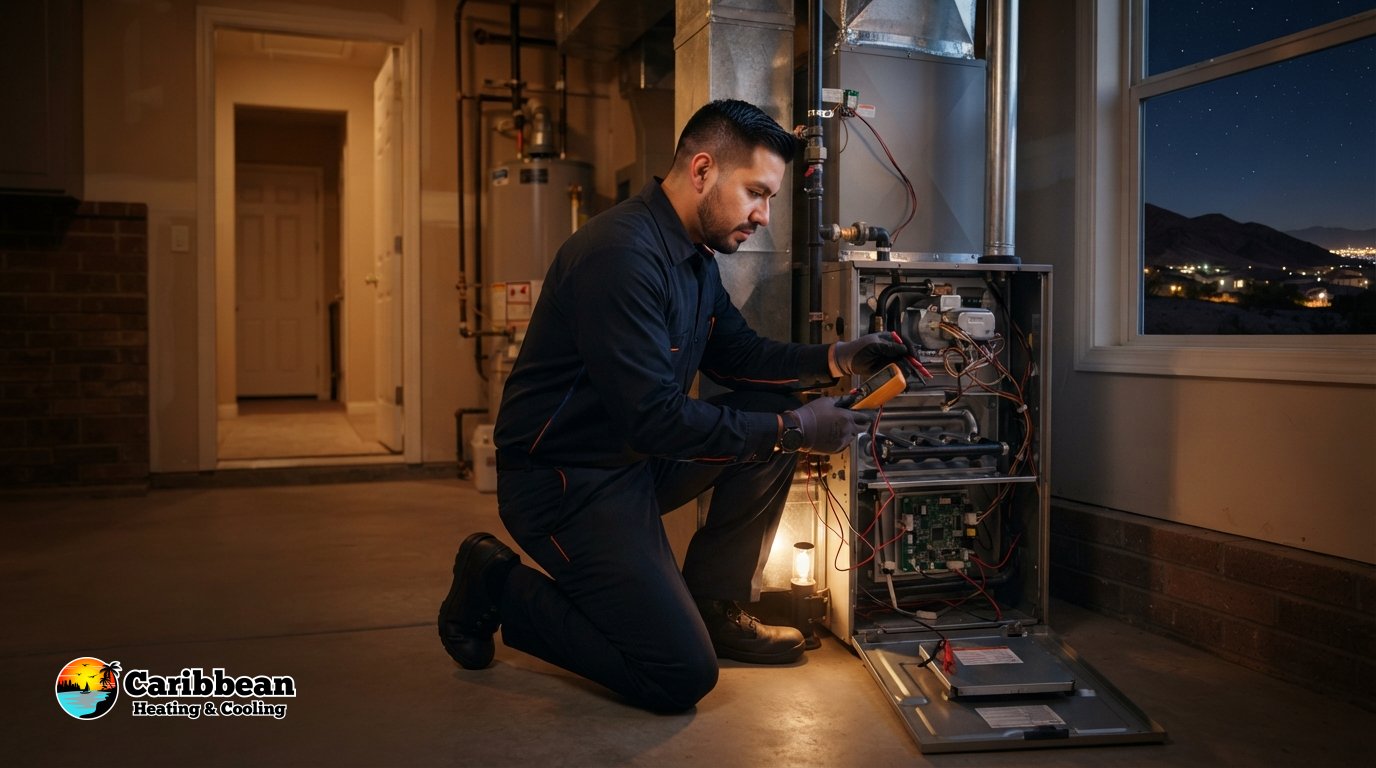
System failures don’t follow a 9-to-5 schedule. If your air conditioning fails at 2 AM on a Saturday in August, the heat inside a Las Vegas home can reach dangerous levels within hours. We provide 24/7 emergency support to ensure you’re never left stranded in the heat. Our team arrives with fully stocked service vehicles to resolve most issues on the first visit, providing the professional reassurance you need during a stressful breakdown. Don’t wait for the next heatwave to test your system’s limits. Schedule your expert AC maintenance today and secure your home’s comfort for the season ahead.
Secure Your Home Comfort for the 2026 Season
Living in the Mojave Desert means preparing for 115-degree peaks that test every component of your HVAC system. By prioritizing bi-annual maintenance and optimizing your thermostat settings, you protect your home against the relentless North Las Vegas dust and rising utility costs. Implementing these best practices for Caribbean Heating & Cooling ensures your equipment operates at peak efficiency through 2026 and beyond. Since 2018, our family-owned team has specialized in residential comfort across Henderson and Summerlin. We provide 24/7 emergency residential support because we know a broken AC at midnight isn’t just an inconvenience; it’s a safety issue. You don’t have to navigate the heat alone when you have specialized residential experts by your side. Trust our licensed technicians to keep your indoor air clean and your energy bills predictable. We’ve spent over 7 years perfecting our approach to the unique climate of the Vegas Valley. We’re ready to help you achieve lasting peace of mind. Keep your home cool with Caribbean Heating & Cooling; Book your 2026 tune-up now!
Your comfort is our top priority, and we look forward to serving your family soon.
Frequently Asked Questions
What are the best thermostat settings for a Las Vegas summer?
Set your thermostat to 78 degrees when you’re at home and 85 degrees when you’re away to balance comfort with energy efficiency. The Department of Energy estimates this strategy saves 10% on annual cooling costs. Using a smart thermostat allows you to pre-cool your home 30 minutes before arrival. This practice protects your system from the strain of 110-degree afternoons while keeping your monthly utility bills manageable.
How often should I change my AC filter in the Nevada desert?
Change your air filter every 30 days during the peak Las Vegas summer months from June through September. Dust levels in the Mojave Desert are 40% higher than the national average, which clogs standard 1-inch filters rapidly. During the milder winter season, you can extend this to every 90 days. Regular replacement ensures optimal airflow and maintains the high standards of best practices for Caribbean Heating & Cooling.
Is it normal for my AC to run constantly when it is over 110 degrees?
It’s normal for your air conditioner to run continuously when outdoor temperatures exceed 110 degrees. Most residential AC units are designed to maintain a 20-degree difference between the outside air and your indoor setting. If it’s 115 degrees outside, your system will struggle to reach 75 degrees without stopping. Keep blinds closed on south-facing windows to reduce the thermal load by 33% and support your equipment.
Why is my AC blowing warm air during a heatwave?
Your AC likely has a tripped circuit breaker or a frozen evaporator coil caused by restricted airflow. Check your electrical panel first and reset any switches that have flipped. Ensure your outdoor condenser unit has at least 2 feet of clear space for proper heat dissipation. If the air doesn’t cool within 15 minutes of a reset, call a professional to check for refrigerant leaks or capacitor failure.
Does Caribbean Heating & Cooling offer emergency residential repairs in Henderson?
Yes, Caribbean Heating & Cooling provides 24/7 emergency residential repairs for all Henderson zip codes. Our technicians aim for a 60-minute response time to ensure your family stays safe during extreme heat events. We prioritize urgent calls where indoor temperatures exceed 85 degrees. Our fully stocked service vans carry 90% of common replacement parts to complete most repairs on the initial visit without delay.
How can I lower my cooling bill without turning off the AC?
Use ceiling fans to create a wind-chill effect that makes a room feel 4 degrees cooler than the actual temperature. This allows you to raise the thermostat setting without losing comfort. Close blackout curtains between 10:00 AM and 6:00 PM to block 75% of solar heat gain. Implementing these best practices for Caribbean Heating & Cooling can reduce your monthly energy consumption by 15% to 20%.
What is the difference between AC maintenance and duct cleaning?
AC maintenance involves a 21-point inspection of the mechanical components like motors and coils to ensure operational efficiency. Duct cleaning is the physical removal of dust and debris from your home’s air distribution channels. While we recommend annual maintenance every spring, duct cleaning is typically only necessary every 3 to 5 years. Both services work together to improve your indoor air quality and system longevity.
Is a heat pump or a furnace better for Las Vegas winters?
A high-efficiency heat pump is the superior choice for Las Vegas because our winter temperatures rarely drop below 30 degrees. Heat pumps provide up to 300% efficiency by moving heat rather than generating it through combustion. This technology handles both cooling and heating needs in one single unit. For homes with existing gas lines, a dual-fuel system offers a reliable backup for the few nights when temperatures hit freezing.
What about maintenance for other critical home systems like plumbing?

Related Posts
Comments (0)