
El costo de instalación de una bomba de calor en North Las Vegas depende del tipo y la capacidad del sistema, los ductos y la instalación eléctrica...
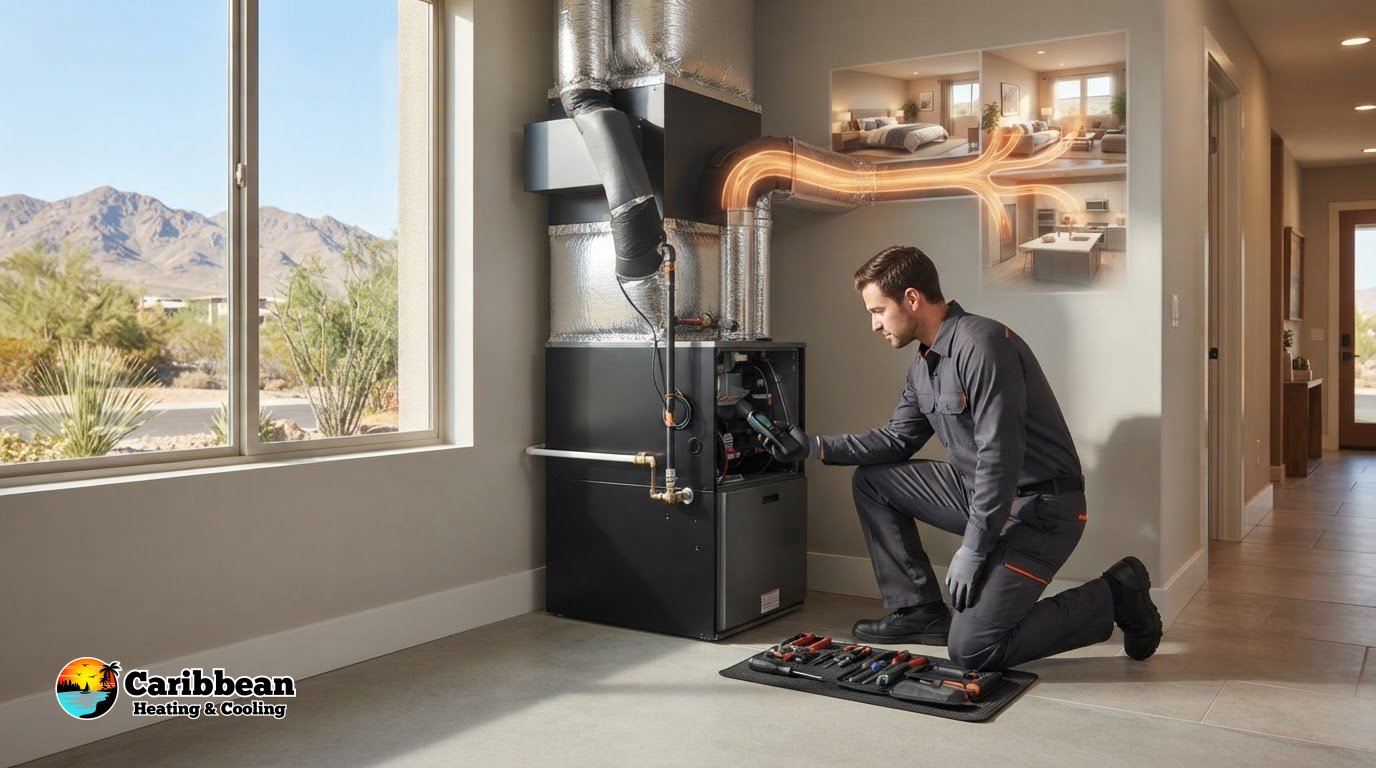
Furnace Size for a 2000 Sq Ft Henderson Home: BTUs and Cost
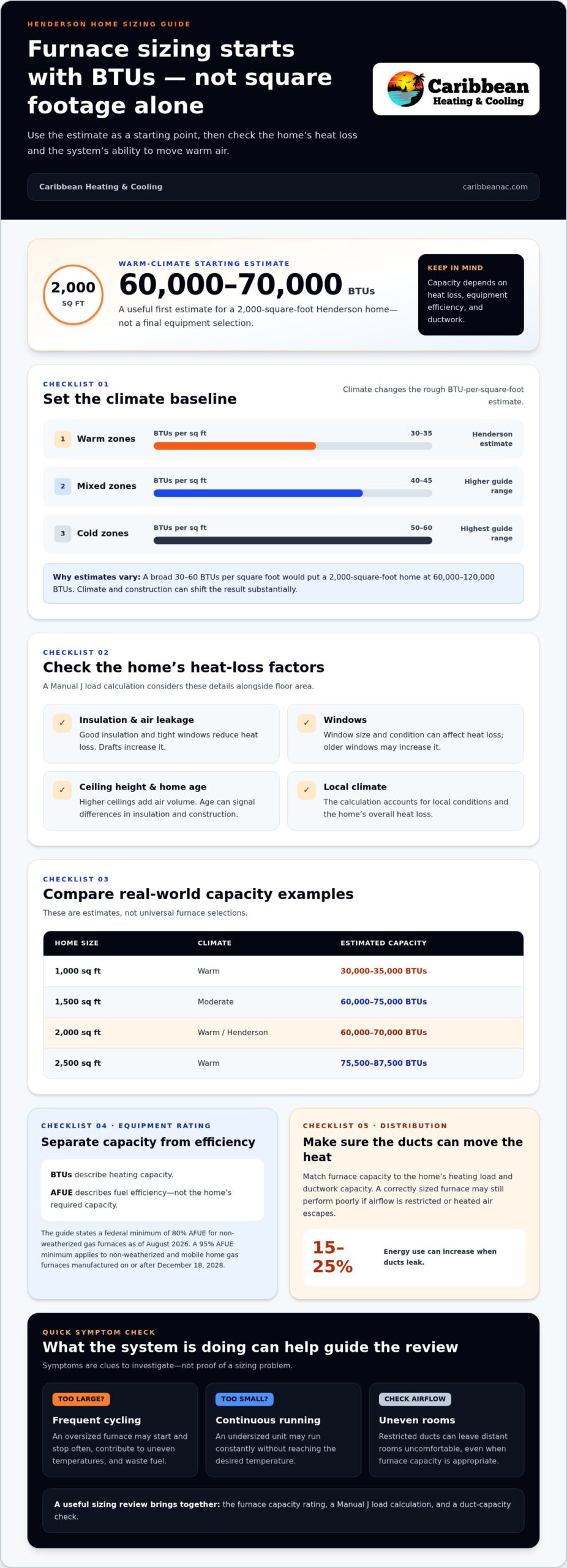
Square footage alone can’t determine whether a furnace will heat your Henderson home evenly. For a 2,000 sq ft home, a quick warm-climate estimate is 60,000 to 70,000 BTUs; that’s a starting range for deciding what size furnace a 2,000 sq ft home in Henderson may need, not a final equipment selection.
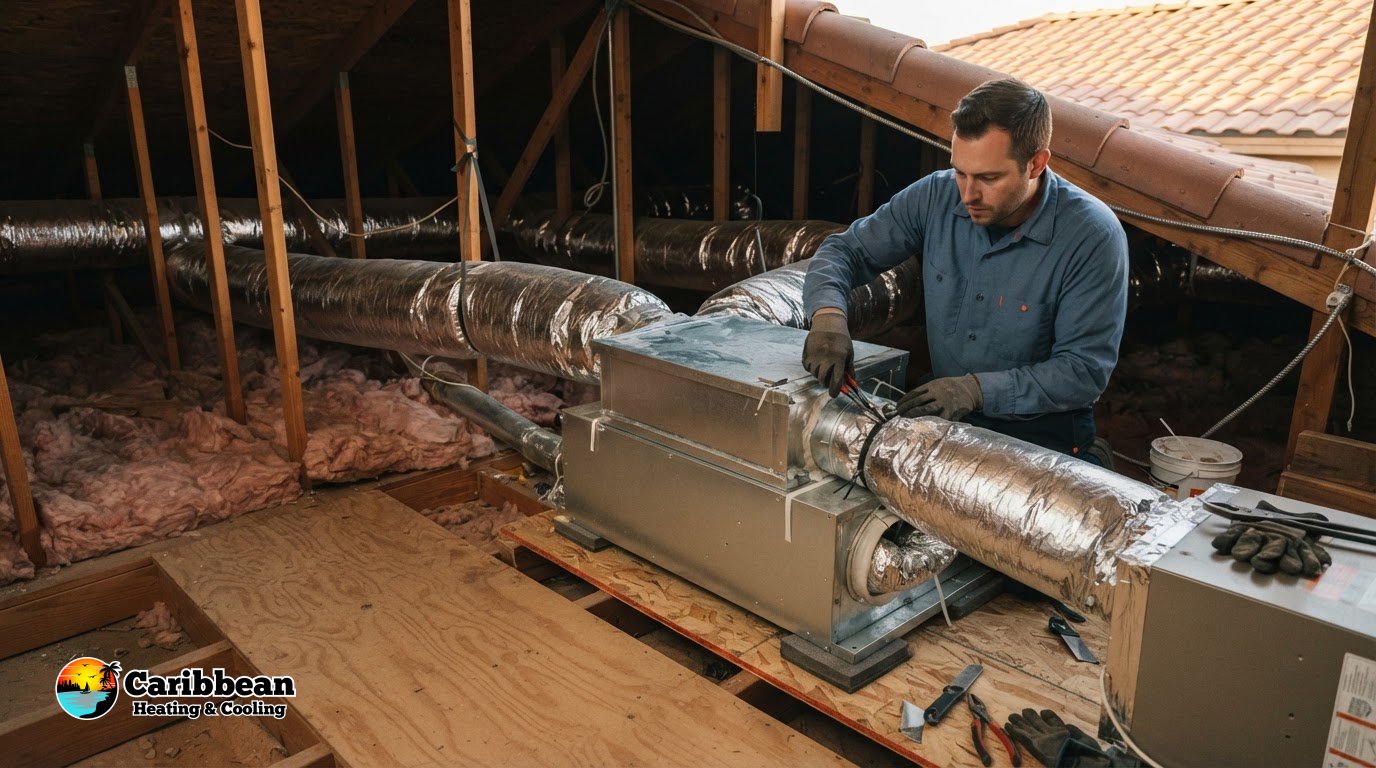
Ductwork matters, too. Even a correctly sized furnace can struggle to distribute heat if the ducts cannot support the required airflow, so assess the heating system as a whole.
This guide explains how Henderson’s climate, insulation, ceiling height, and duct capacity affect furnace sizing, and how efficiency and installation requirements influence the project. Floor area offers a starting point, but it is not enough on its own to choose a furnace confidently.
Key Takeaways
- Compare furnace input BTUs with heat output and AFUE so you can understand what a capacity rating means for comfort.
- See how home size and Henderson’s warm climate shape a starting estimate, and why insulation and ceiling height can shift it.
- Learn which equipment and installation factors influence furnace cost without relying on a square-foot price shortcut.
- Recognize how a furnace that’s too large or too small can affect cycling, comfort, and fuel use.
How Many BTUs Does Your Furnace Need per Square Foot?
For a 2,000-square-foot Henderson home, a warm-climate estimate is 60,000 to 70,000 BTUs. Treat this as a starting point: capacity also depends on heat loss, equipment efficiency, and ductwork.
Furnace Size Estimates for Two-Thousand-Square-Foot Homes
BTU estimates approximate the heating capacity needed for a home’s floor area. For homeowners asking what size furnace for a 2,000-square-foot home in Henderson, the warm-climate range is 60,000 to 70,000 BTUs. A broad 30-to-60-BTU-per-square-foot estimate yields 60,000 to 120,000 BTUs, showing how much climate and construction can change the result.
Climate-Based BTU Estimates
Climate zones provide a rough BTU-per-square-foot guide: warm zones use 30 to 35, mixed zones 40 to 45, and cold zones 50 to 60. Henderson’s warm-climate estimate points to 60,000 to 70,000 BTUs for this home size. According to the U.S. Department of Energy, the federal minimum efficiency for non-weatherized gas furnaces is 80% AFUE as of August 2026. The 95% AFUE minimum applies to non-weatherized and mobile home gas furnaces manufactured on or after December 18, 2028, according to the U.S. Department of Energy. AFUE ratings describe fuel efficiency, not the home’s required capacity.
Limits of Square-Footage Sizing
Square-footage estimates are rough. A Manual J load calculation considers local climate, insulation, windows, ceiling height, air leakage, and airflow. When comparing proposals, review the stated capacity, efficiency, and installation scope, and check that the work meets applicable licensing and qualification requirements. Choosing a furnace, heat pump, or dual-fuel system depends on the home’s heating needs and system design. Permit and code requirements in Henderson depend on the installation and applicable local rules.
Home Features That Affect Furnace Size
Good insulation and tight windows reduce heat loss; drafts and older windows increase it. Higher ceilings add air volume, while a home’s age can indicate differences in insulation and construction. A Manual J calculation considers these factors alongside square footage, helping homeowners avoid sizing a furnace by floor area alone. Duct airflow also affects how effectively heat reaches each room.
How Much Does a Furnace Cost by Home Size?
Furnace costs depend on the equipment and installation, not just square footage. Home size and local climate help estimate the required capacity, while efficiency and installation scope shape the project.
Climate and Winter Heating Needs
Climate-zone BTU guidelines estimate heating demand from regional conditions and home size. Warm climates use about 30 to 35 BTUs per square foot; moderate climates use 40 to 45, and cold climates use 50 to 60. For example, a 1,000-square-foot warm-climate home estimates at 30,000 to 35,000 BTUs. Colder winter temperatures raise heating demand, while a Manual J calculation also accounts for local climate and heat loss. A window’s size and condition can affect that loss.
Typical Furnace Capacity in Henderson
For a 2,000-square-foot home in a warm climate, a common estimate is 60,000 to 70,000 BTUs per hour. That gives Henderson homeowners a useful starting point, not a universal capacity for every home in the region. Insulation, windows, and ductwork influence the final sizing. An oversized furnace can cycle too frequently, while an undersized unit may struggle to maintain indoor temperature during colder weather.
For comparison, a 1,500-square-foot moderate-climate home estimates at 60,000 to 75,000 BTUs; a 2,500-square-foot warm-climate home estimates at 75,500 to 87,500 BTUs. These examples show how square footage and climate shift capacity needs. Cooling equipment uses a different capacity measure, so furnace BTUs don’t directly size an air conditioner.
Installed furnace pricing depends on capacity, efficiency, venting, and installation scope; pricing is provided after a quote request. If replacement is needed, heating installation is the relevant next step.
Does furnace size depend on my ductwork?
Yes. Furnace capacity needs to match the home’s heating load and ductwork capacity. For a 2,000-square-foot Henderson home, a square-foot estimate alone can’t show whether ducts move enough airflow. A Manual J load calculation paired with a duct-capacity check assesses both the equipment and its distribution system.
An oversized furnace may short-cycle, starting and stopping frequently instead of running steadily. This can lead to uneven temperatures and wasted fuel. Quick heating cycles followed by rooms that still feel uncomfortable are worth investigating, though they do not prove the furnace is oversized.
An undersized furnace may run continuously without bringing the home to the desired temperature. In colder weather, it can leave distant rooms uncomfortable, especially when duct airflow is restricted. Comparing the furnace’s capacity with the home’s load calculation can help distinguish a sizing problem from an airflow issue.
Duct condition matters as well as duct capacity. Leaks can increase energy use by 15% to 25%, so a correctly sized furnace may still perform poorly if heated air escapes. Insulation, ceiling height, and climate zone affect the load calculation, while duct restrictions affect how heat reaches each room.
For a practical review, note whether the system cycles quickly, runs continuously, or leaves rooms unevenly heated. Share those patterns alongside the furnace rating and load calculation. Get help reviewing furnace sizing and duct capacity so the system’s heating output and airflow can be assessed together.
Caribbean Heating & Cooling: AC Repair
Caribbean Heating & Cooling helps homeowners in Henderson, Las Vegas, North Las Vegas, and Summerlin address heating problems that affect comfort and system performance. If your furnace runs constantly, cycles frequently, or leaves rooms unevenly heated, Heating Repair can help identify the issue. If you’re replacing an aging furnace, ask about Heating Installation for your home.
Furnace sizing depends on more than floor area. The home’s heating load, furnace capacity, and ductwork all affect performance. Share the symptoms you’ve noticed and any available details about your current furnace to help focus the discussion. For cooling concerns, Caribbean Heating & Cooling also offers AC Repair.
Contact Caribbean Heating & Cooling to discuss your home’s heating needs, or visit caribbeanac.com.
Plan Your Next Comfort Upgrade
Choosing what size furnace a 2,000 sq ft home in Henderson needs is a chance to plan for comfort beyond the next cold spell. Consider how the heating system fits your home’s overall comfort needs, including cooling performance and seasonal maintenance. A coordinated approach can help you make informed decisions about future equipment work instead of treating each concern in isolation.
If you’re planning an upgrade or addressing a comfort problem, Caribbean Heating & Cooling offers AC Repair, AC Installation, and AC Maintenance. Contact the team to discuss your home’s needs and the next practical step.
Contact Caribbean Heating & Cooling and move forward with confidence.
Frequently Asked Questions
Is a bigger furnace better?
No. A higher-capacity furnace is not automatically more comfortable or efficient. If it heats the area around the thermostat quickly, it may shut off before warmth spreads through the home, then restart repeatedly. If you notice frequent starts and stops, compare the furnace’s capacity with your home’s heating needs rather than assuming a larger replacement will solve comfort problems.
How many BTU do I need for 1,500 sq ft?
Climate changes the estimate for a 1,500-square-foot home: about 45,000 to 52,500 BTUs in a warm climate, 60,000 to 75,000 in a moderate climate, and 75,000 to 90,000 in a cold climate. These ranges show why the same floor area can call for different equipment. Insulation and air leakage also influence heating demand.
What Else Moves Your Furnace Price Beyond Square Footage?
Beyond square footage, price depends on furnace capacity and efficiency, venting needs, and the installation work involved. Existing ductwork and the home’s layout can affect the project scope, too. The price depends on the case and is given after a quote request; these factors help explain why two homes with similar floor areas can have different installation quotes.
What Happens If You Get The Wrong Furnace Size?
An undersized furnace may run continuously and still leave the home below the desired temperature; an oversized unit may cycle too often and heat rooms unevenly. Before assuming the equipment is the cause, compare its capacity with the home’s heating load and consider whether airflow reaches each room. This can help distinguish sizing concerns from heat distribution problems.
What furnace size is recommended for a 2,000 sq ft home in Henderson, Nevada?
If you’re deciding what furnace size a 2,000-square-foot home in Henderson needs, use 60,000 to 70,000 BTUs as a warm-climate starting estimate. It’s not a universal selection for every home. Insulation, air leakage, and the system’s airflow affect the heating load, so consider those details alongside floor area when evaluating a furnace size.

Related Posts
Comments (0)