
¿Qué pasaría si su aire acondicionado deja de funcionar al anochecer durante una ola de calor en Summerlin? El servicio de emergencia para HVAC...
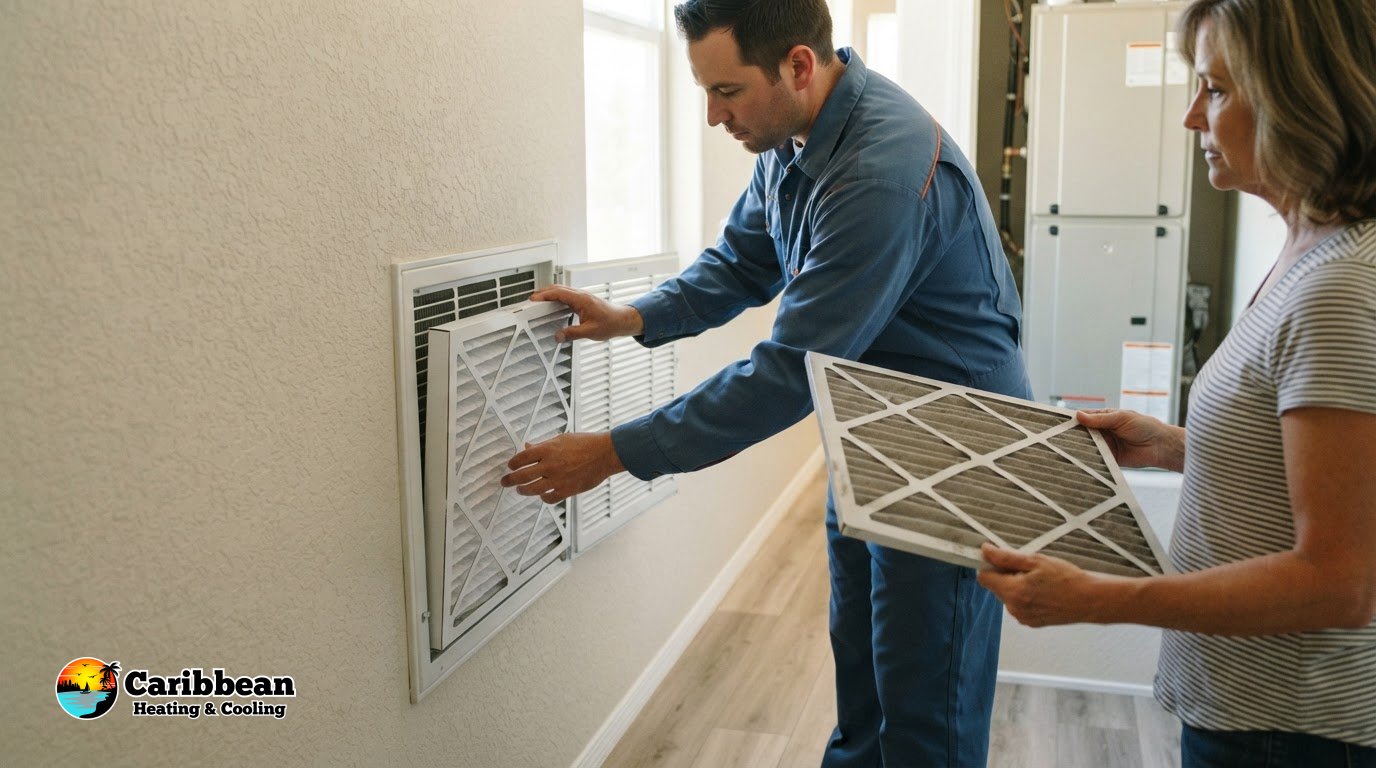
MERV Rating for Dusty Climates: Choosing a Home HVAC Filter
The best MERV rating for air filters in dusty climates is usually between MERV 8 and MERV 13, as long as your HVAC system can handle the filter’s airflow resistance. MERV 8 can capture larger particles such as dust, while MERV 11 to 13 filters can capture smaller particles. A higher rating isn’t automatically the better choice if it restricts airflow too much.
In dusty climates, it’s natural to want a filter that captures as much dust as possible. The best MERV rating for air filters in dusty climates depends on what your HVAC system can handle: filtration must be balanced with adequate airflow. This guide explains how MERV ratings work and how to choose a compatible filter for your home in Las Vegas, Henderson, North Las Vegas, or Summerlin.
Key Takeaways
- Use the MERV rating to understand which particle sizes a filter can capture, not as the only measure of fit.
- Balance finer filtration with airflow: a filter that’s too restrictive can affect HVAC performance.
- Choose a filter that matches your system’s specifications and the dust conditions in your home.
- Keep filtration effective by accounting for how quickly dust builds up and your system’s filter needs.
What Is a MERV Rating?
MERV measures how effectively an air filter captures particles of different sizes. Residential filters commonly use ratings from 1 to 16, while the ASHRAE rating system extends from 1 to 20.
Understanding the MERV Scale
MERV, or Minimum Efficiency Reporting Value, measures how effectively a filter captures particles. A higher rating generally captures smaller particles, but that does not automatically make the filter suitable for your HVAC system. Choose based on both the particles you want to capture and the airflow your system needs. Dust, pollen, and pet dander vary in size, so the right filter depends on your household’s needs and equipment.
Particle Sizes in Filter Testing
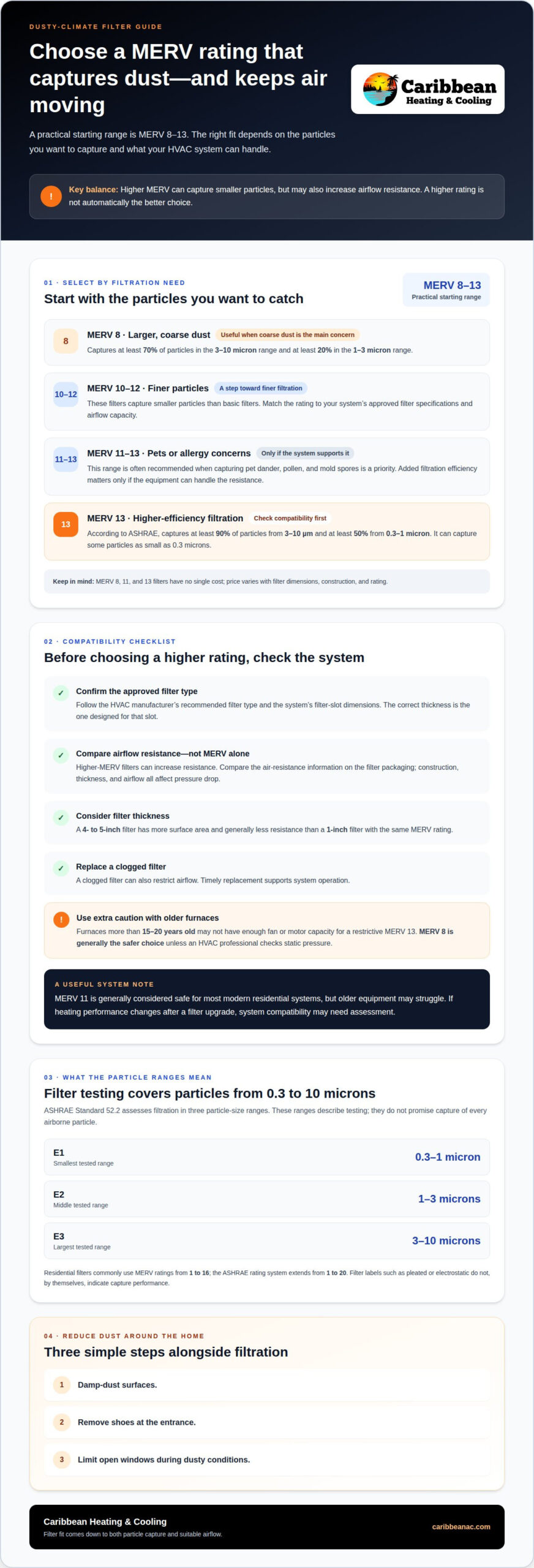
ASHRAE Standard 52.2 uses three particle-size ranges to assess filtration: E1 covers 0.3 to 1 micron, E2 covers 1 to 3 microns, and E3 covers 3 to 10 microns. MERV-rated filters are tested against particles from 0.3 to 10 microns. These ranges show what “smaller particles” means in testing, rather than promising capture of every airborne particle. Filter type labels, such as pleated or electrostatic, don’t by themselves indicate capture performance. Compare the MERV rating and system compatibility.
Dust Removal Across MERV Ratings
MERV 8 filters capture at least 70% of particles in the 3-10-micron range and at least 20% in the 1-3-micron range. MERV 11 targets smaller particles, including those in the 1-3-micron range. MERV 13 captures at least 90% of particles from 3-10 µm, according to ASHRAE, and at least 50% from 0.3 to 1 micron. For dust removal, the best fit depends on particle sizes and airflow needs. MERV 8, 11, and 13 filters have no single cost; price varies with filter dimensions, construction, and rating.
Air resistance and HVAC-system compatibility
A filter’s particle capture matters only if your HVAC system can move air through it. Higher-MERV filters can increase resistance, so match filtration to the system’s airflow capacity.
Compatibility With Higher-MERV Filters
Compatibility means the filter captures particles without restricting airflow beyond what the heating or cooling system can handle. MERV 11 is generally considered safe for most modern residential systems, but older equipment may struggle. A higher rating can help capture pollen and allergens, yet the manufacturer’s recommended filter type and the system’s fan capacity matter. Filter thickness matters too: 4- to 5-inch filters have more surface area and generally less resistance than 1-inch filters with the same MERV rating.
Airflow Resistance and Pressure Drops
Air resistance describes how much a filter impedes airflow, while pressure drop measures the change in air pressure across it. MERV 13 filters don’t all create the same pressure drop; construction, thickness, and airflow affect resistance. Compare the air-resistance information on filter packaging, rather than relying on MERV alone. A clogged filter can also restrict airflow, so timely replacement supports system operation.
Most home HVAC systems use 1-inch filters, but the correct dimensions and thickness are those designed for the system’s filter slot. Dust indoors can also be reduced by damp-dusting surfaces, removing shoes at the entrance, and limiting open windows during dusty conditions. In commercial settings where dust control is equally important, maintaining a structured routine such as the checklist outlined on advancecleaningservices.ca can help manage indoor airborne particles and reduce strain on ventilation systems.
MERV 13 Filters in Older Furnaces
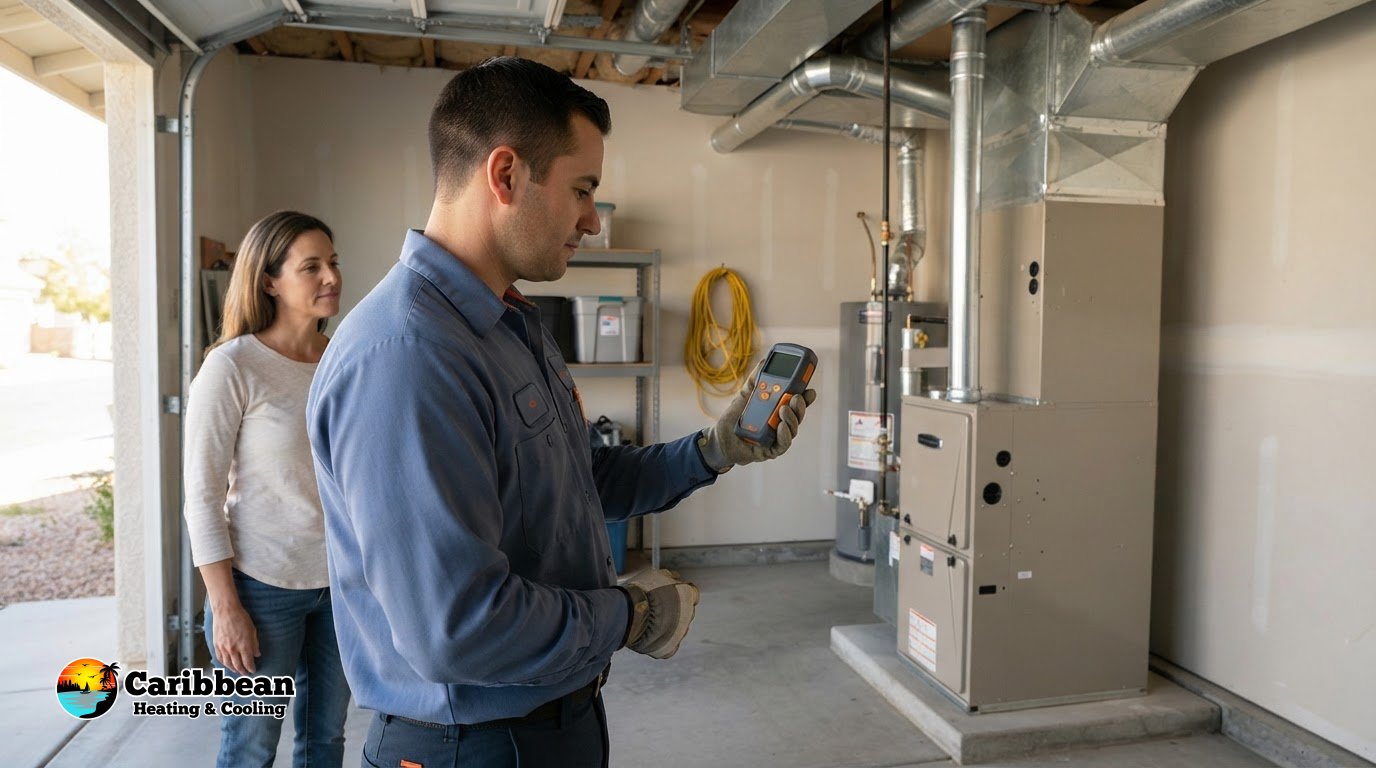
Older furnaces may not have enough fan or motor capacity for a restrictive MERV 13 filter. For furnaces more than 15-20 years old, MERV 8 is generally the safer choice unless an HVAC professional checks static pressure. If heating performance changes after a filter upgrade, indoor air quality support can help assess filtration and system compatibility.
Recommended MERV rating for home HVAC filters
For most homes, a practical starting range is MERV 8 to 13. The best choice depends on the dust you want to capture and whether your system can maintain airflow through the filter. A higher rating can improve filtration of smaller particles, but greater resistance may make it a poor match for some equipment.
MERV 6-8 filters provide basic protection against larger particles, including household dust and lint. MERV 8 captures at least 70% of particles from 3-10 microns, making it a useful option when coarse dust is the main concern. Choose based on your system’s approved filter rating, not dust levels alone.
For finer dust, MERV 10-12 filters capture smaller particles, while MERV 11-13 filters are often recommended for homes with pets or allergy concerns. That range can help capture pet dander, pollen, and mold spores. The added efficiency matters most when those particles are a priority and the HVAC system can handle the filter’s resistance.
MERV 13 offers higher-efficiency filtration, including capture of some particles as small as 0.3 microns. Higher-MERV filters also have a better chance of trapping bacteria and some spores. But a rating alone doesn’t guarantee better indoor air quality: the filter must fit correctly and allow adequate airflow for heating and air conditioning. For larger facilities and commercial properties, HVAC specialists like GAP Mechanical emphasize evaluating airflow and equipment capacity before upgrading to denser filters.
In short, consider MERV 8 for larger dust, MERV 10-12 for finer particles, and MERV 13 when the system supports it. For help matching filtration to your home’s equipment, get indoor air quality guidance.
Caribbean Heating & Cooling
Caribbean Heating & Cooling can help you connect filter choice with how your home’s heating and cooling equipment operates. If dust remains a concern or a higher-rated filter affects airflow, AC or heating maintenance can help assess system performance. Repair or installation may be relevant when equipment problems affect comfort or operation.
MERV rating is only one factor in indoor air quality. The filter must fit your system and allow suitable airflow. For help with the equipment side of the decision, contact Caribbean Heating & Cooling for residential HVAC service in Las Vegas, Henderson, North Las Vegas, or Summerlin.
Make Your Next Filter Choice With Confidence
Filtration needs can shift with dust conditions, household routines, and equipment performance. Revisit your filter choice when conditions change, rather than treating it as a one-time decision. The best MERV rating for air filters in dusty climates is one that supports your indoor air goals while remaining compatible with your HVAC system.
If dust concerns continue or your system’s performance changes, professional service can address equipment issues. Caribbean Heating & Cooling provides residential AC repair, installation, and maintenance in Las Vegas, Henderson, North Las Vegas, and Summerlin.
Take the next step toward dependable home comfort. Contact Caribbean Heating & Cooling to discuss your HVAC needs.
Frequently Asked Questions
How Often Should You Change It?
In a dusty home, inspect the filter regularly and replace it when dust buildup appears heavy or airflow seems reduced. MERV 8 filters are commonly replaced every 2-3 months, but dusty homes may need monthly replacement. Pets, heavy system use, and seasonal dust can also shorten the interval, so follow the filter and HVAC manufacturer’s maintenance instructions.
How do I know if my filter is too restrictive?
Reduced airflow from vents, uneven temperatures, or weaker heating and cooling can point to a filter or system airflow problem, though other causes are possible. Check that the filter is clean, installed in the correct direction, and the size specified for your system. If the problem continues after replacement, have the system assessed.
What MERV rating is best for air filters in dusty climates?
For dusty homes, MERV 8 can be a practical choice for capturing larger dust, while MERV 11 or 13 targets smaller particles. The best rating depends on your HVAC system’s airflow capacity and the particles you want to capture. If dust is mostly visible on surfaces, filtration needs may differ from concerns about fine airborne particles.
Can a home HVAC system safely use a MERV 13 filter?
A home HVAC system can use MERV 13 if it’s designed to handle the filter’s added airflow resistance. This is especially important for older furnaces, which may have less fan or motor capacity. If your system’s age or performance raises concerns, a technician can assess static pressure and help determine a suitable filter rating.
How can I check whether a high-MERV filter restricts HVAC airflow?
Start with the HVAC manufacturer’s recommended filter type and size. After installing it correctly, note any changes in airflow or heating and cooling performance. A technician can measure static pressure to assess how a higher-MERV filter affects airflow. Filter thickness and construction also influence resistance, so the MERV rating alone does not tell the whole story.

Related Posts
Comments (0)