
El costo de instalación de una bomba de calor en North Las Vegas depende del tipo y la capacidad del sistema, los ductos y la instalación eléctrica...
Can Your Old Ductwork Handle a High-Efficiency AC?
A high-efficiency AC can work with old ductwork, but only if the ducts can deliver the airflow the system needs. Whether your old ductwork can handle a new high-efficiency AC depends on its condition, design, and fit with the equipment, not age alone.
It’s reasonable to wonder whether replacing the AC means replacing the ducts, too. The answer isn’t automatically yes or no: leaks, poor insulation, restricted airflow, or incorrectly sized ducts can affect comfort and system performance, especially during Las Vegas summers.
This article explains what to look for, how duct design and condition affect performance, and what a professional assessment considers. You’ll learn when existing ducts may be suitable, when targeted modifications could help, and when replacement may be the better option.
Key Takeaways
- Age alone doesn’t determine whether existing ducts are suitable; their condition, insulation, layout, and sizing all matter.
- Airflow measurements and checks of supply and return ducts can reveal whether the system is likely to deliver the cooling your home needs.
- Leaks, damage, or poor design may call for targeted duct changes or replacement rather than simply connecting a new AC.
- Use the assessment findings to guide your AC installation or repair plan and address duct issues that could undermine comfort.
Ductwork modifications for air conditioning
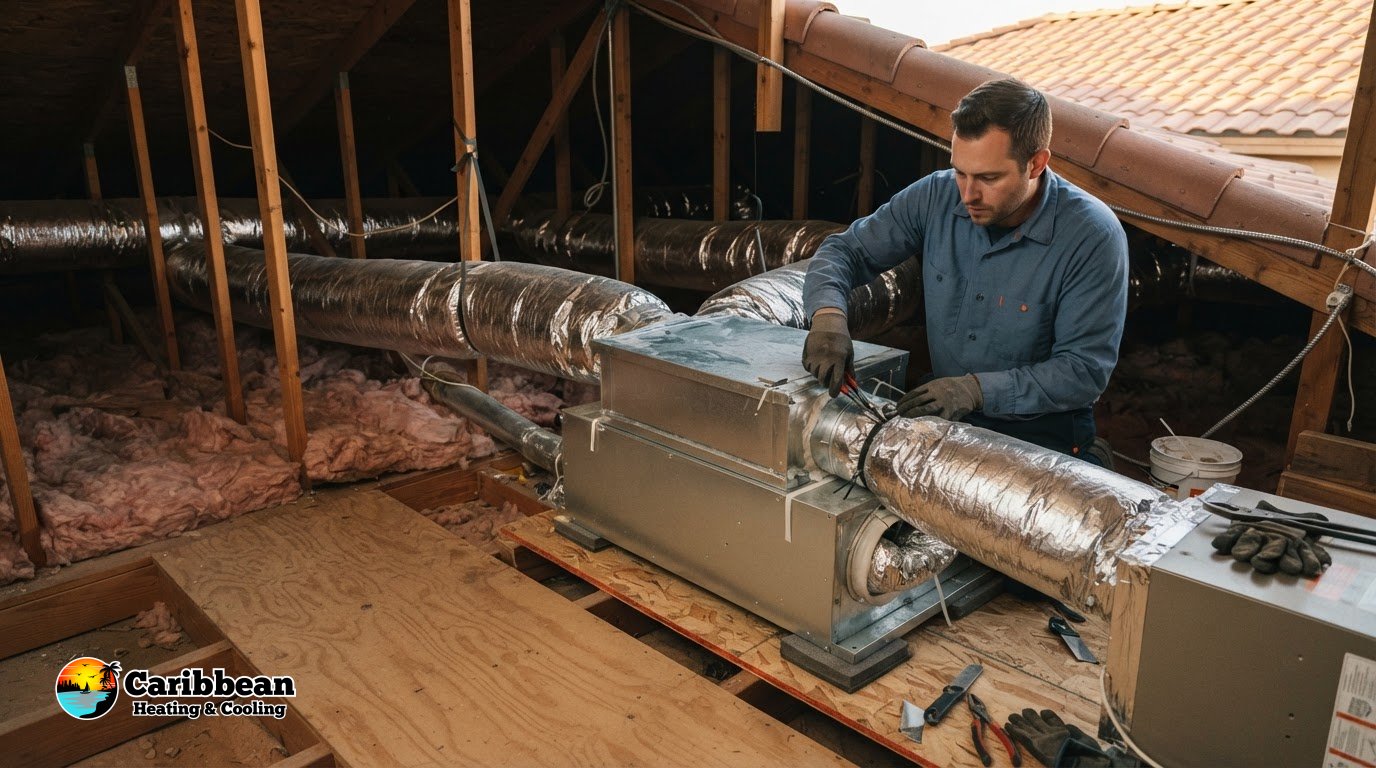
In Las Vegas, existing ducts may support a high-efficiency AC if their condition, insulation, and airflow suit the equipment. Modifications can range from sealing a loose joint to replacing an undersized section.
Conditions for Reusing Existing Ducts
Existing ducts may be reused when they’re intact, appropriately sized and insulated, and able to distribute air throughout the home. Replacing ducts that already serve the system effectively may be unnecessary.
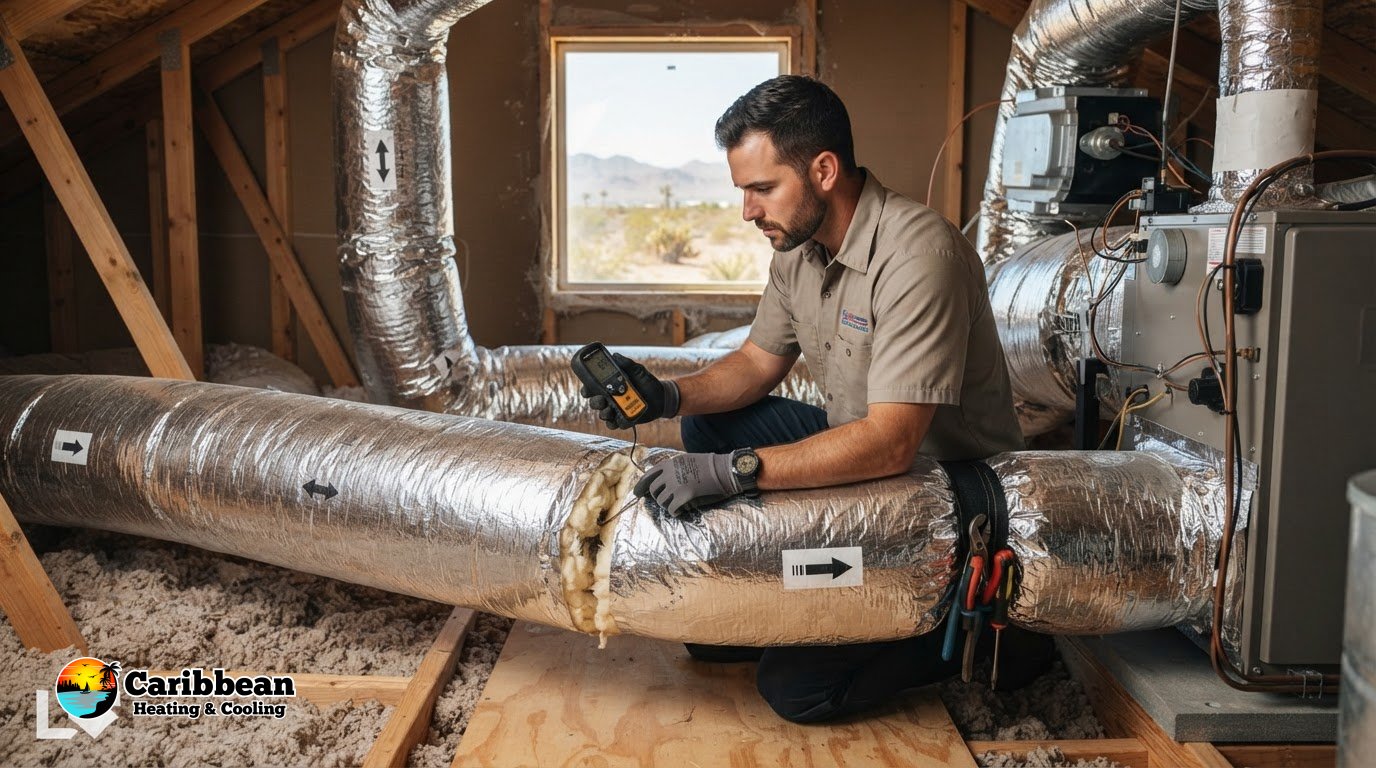
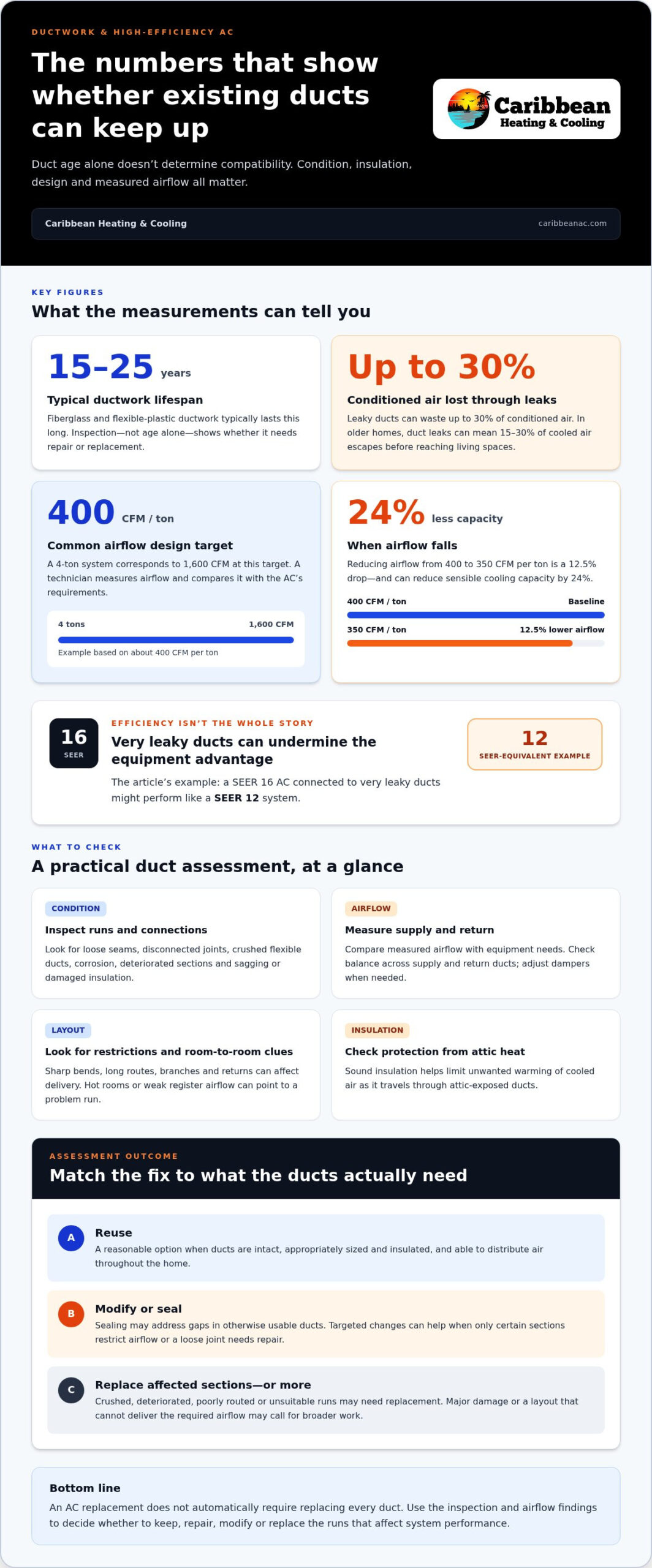
Look for connected supply and return runs, secure seams, and insulation that hasn’t sagged or deteriorated. Leaky ducts can waste up to 30% of conditioned air, so sealing gaps may be a better fit than wholesale replacement. Ducts exposed to attic heat may benefit from sound insulation to limit unwanted warming before cooled air reaches rooms.
Duct Age and Condition
Age helps flag possible wear, but a physical inspection shows whether ducts need modification. Fiberglass and flexible-plastic ductwork typically lasts 15 to 25 years.
As ducts age, check for loose seams, crushed flexible runs, damaged insulation, and corrosion or deterioration around connections. Ductwork in the 15-to-20-year range may develop gaps or damage, but age alone doesn’t establish whether it can serve a new system. For example, a newer, intact run may remain usable, while a damaged section in an older system may need repair or replacement.
Upgrade Requirements for AC Replacements
Permit and code requirements depend on the replacement scope and any ductwork changes. Replacing an AC doesn’t automatically mean every existing duct must be upgraded.
Separate the equipment replacement from proposed duct modifications: changing the layout, replacing sections, or altering connections can raise different permit questions than keeping existing runs. Before work begins, identify which ducts will remain and which will be changed, then include those details in the project scope. This helps clarify whether a duct upgrade is a performance choice, a required part of the work, or both.
Professional duct and furnace assessment
A professional assessment considers the equipment, duct condition, and airflow together. This helps determine whether existing ducts can deliver the air a new AC needs.
Duct Leakage and Energy Loss
Duct leakage lets conditioned air escape before reaching living spaces, reducing the cooling delivered to rooms. Older homes can lose 15% to 30% of cooled air through duct leaks. During an assessment, the technician examines joints, seams, and connections across supply and return runs. Leaks matter because the AC must work harder to maintain comfort when cooled air escapes into an attic or other unconditioned area.
Sealing or Replacing Ducts
Sealing closes gaps in otherwise usable ducts, while replacement addresses sections that are damaged or unsuitable. A technician can distinguish a loose seam from a crushed, poorly routed, or deteriorated run. Return ducts need attention, too, not just supply ducts. In a two-story home with uneven upstairs cooling, the layout may show that an upstairs return could improve air circulation.
Duct Sizing and Airflow
Duct sizing determines how much air can move through the system without excessive restriction. Assessment includes measuring airflow and comparing it with the AC’s requirements. A common design target is about 400 cubic feet per minute per ton, so a 4-ton system corresponds to 1,600 CFM. Reducing airflow from 400 to 350 CFM per ton, a 12.5% drop, can reduce sensible cooling capacity by 24%. The technician also checks whether supply and return airflow are balanced and adjusts dampers when needed. For help matching equipment to duct conditions, explore this AC installation guidance.
Poorly designed or damaged ductwork
A high-efficiency AC can’t overcome ducts that restrict airflow or leak conditioned air. In Las Vegas, attic heat can make damaged or poorly insulated runs more problematic. Crushed flexible ducts, disconnected joints, and sharp bends can obstruct airflow, leaving some rooms uncomfortable while others cool adequately. Damage from construction work or other events may require major repairs or full duct replacement.
Design matters as much as visible condition. A duct layout sized for a smaller, older AC may not deliver enough air for larger replacement equipment. For example, increasing system capacity from 3 tons to 4 tons can leave existing ducts undersized. The equipment’s capacity alone doesn’t show whether the home will receive suitable airflow; duct dimensions, route length, branches, and returns all affect delivery.
Look for persistently hot rooms, weak airflow at a register, or ducts that have sagged or separated. These signs can point to different problems, so the affected runs and connections need inspection. A loose joint may be repairable, while crushed, deteriorated, or poorly routed sections may need replacement. If only part of the layout restricts airflow, modifying those sections may be more appropriate than replacing every duct.
Leaky ducts can also undermine the efficiency advantage of new equipment. A SEER 16 AC connected to very leaky ducts might perform like a SEER 12 system. That example shows why matching the duct system to the AC matters as much as choosing an efficiency rating. For an AC installation that accounts for equipment and duct compatibility, plan your AC installation.
Caribbean Heating & Cooling: AC Repair
Caribbean Heating & Cooling can help with AC trouble caused by equipment problems or when it’s time to replace an aging system. If rooms cool unevenly or airflow seems weak, AC Repair can address system issues. If you need to replace the unit, AC Installation is the relevant next step.
Describe what you’ve noticed, such as warm rooms, unusual system performance, or visible duct damage. This context helps connect the AC concern with the right service. AC Maintenance can also help keep an existing system operating as intended. Duct condition and compatibility still matter, so use the assessment findings to guide your next decision.
Contact Caribbean Heating & Cooling to discuss your AC repair or installation needs.
Plan Your Next AC Step with Confidence
Before planning a replacement, note which rooms feel uncomfortable and when the problem occurs. These observations provide a useful starting point for discussing your HVAC needs and connecting equipment decisions to everyday comfort. If you’re asking whether your old ductwork can handle a new high-efficiency AC, include these details in your decision.
Caribbean Heating & Cooling offers AC Repair when the current system has a fault, AC Installation for a replacement, and AC Maintenance for ongoing care. The right service depends on whether you need to restore operation, install new equipment, or maintain a working system. A clear description of the symptoms can help focus the discussion on your home’s needs.
Explore your next AC service step with Caribbean Heating & Cooling and move forward with a plan for dependable home comfort.
Frequently Asked Questions
Can existing ductwork handle a higher SEER-rated AC unit?
Yes, existing ducts can serve a higher SEER-rated AC when their airflow capacity and layout match the equipment. The efficiency rating alone doesn’t determine compatibility. For a Las Vegas home, consider how the system performs during sustained summer heat: uneven cooling, noisy airflow, or frequent cycling can signal a mismatch between the AC and duct network.
What if my existing ducts cannot be modified for a new AC?
If the duct layout can’t be altered, choose equipment suited to its airflow limits rather than forcing a mismatch. The design may also call for a different air-distribution approach, such as a ductless heat pump, instead of replacing all the ductwork. The key is to match the home’s cooling needs with a system that can deliver comfort through the available configuration.
When should you replace ductwork when installing a new AC system?
Replace ducts when damage or poor design affects much of the system, or when repairs can’t restore reliable airflow. Isolated defects may require replacing only the affected runs. Look for repeated separation, crushed sections, deteriorated insulation, or a layout that prevents rooms from receiving enough air. These conditions can make keeping the existing network impractical during an AC replacement.
How do HVAC contractors determine whether existing ductwork is sized for a new AC system?
HVAC professionals compare the home’s cooling load and equipment specifications with the duct system’s capacity. They examine duct dimensions, branch layout, return-air paths, and measured airflow, then look for restrictions that could limit delivery. The assessment should also consider room-by-room comfort: a system may move air overall but still leave an upstairs bedroom short of cooling.
What duct sizing rules and airflow requirements apply to high-efficiency air conditioners?
A common design reference is approximately 400 CFM per ton for 2026 high-efficiency requirements, compared with approximately 350 CFM per ton under legacy duct standards. These are airflow benchmarks, not a universal duct-size prescription. The required duct dimensions depend on equipment capacity, run length, layout, and resistance. A qualified design should account for the full system, including returns.

Related Posts
Comments (0)