
Al comparar los costos y beneficios del purificador de aire con luz UV para HVAC, la primera pregunta es en qué parte del sistema debe actuar. Una...
Las Vegas HVAC Replacement Cost Calculator: 2026 Price Guide
When the July sun pushes Las Vegas temperatures past 110 degrees, your HVAC system isn’t just a luxury; it’s a critical safety net for your home. You’ve likely noticed your NV Energy bills climbing or heard a concerning rattle from your outdoor condenser, which is why you’re searching for a reliable Las Vegas hvac replacement cost calculator to plan your next move. It’s a difficult choice when you’re balancing immediate household budgets against the absolute necessity of desert reliability.
This guide helps you master the math behind a major home investment while navigating the unique demands of the Mojave climate. You’ll learn how the 2024 IECC standards effective this January change installation requirements and why the “$5,000 Rule” is a vital tool for your decision. We’ll also dive into the 2026 NV Energy PowerShift rebates that can offset the cost of high-efficiency heat pumps and air conditioning systems. By the end, you’ll have a clear financial roadmap to ensure your home remains a cool sanctuary without the stress of unexpected failures.
Key Takeaways
- Apply the “$5,000 Rule” to determine if repairing your aging unit is a sound investment or if a full replacement is more cost-effective for your long-term budget.
- Use our Las Vegas hvac replacement cost calculator framework to identify the correct system tonnage and SEER2 ratings needed to handle extreme Mojave Desert heat.
- Understand how the 2026 IECC efficiency standards and new refrigerant regulations impact the performance and initial price of your new installation.
- Learn how to claim NV Energy PowerShift rebates and track the rollout of IRA-funded programs to reduce the upfront cost of high-efficiency heat pumps.
- Gain a clear decision-making framework that prioritizes “Desert Reliability” to ensure your home remains a safe, cool sanctuary during peak summer temperatures.
The $5,000 Rule: A Manual HVAC Replacement Calculator for Las Vegas
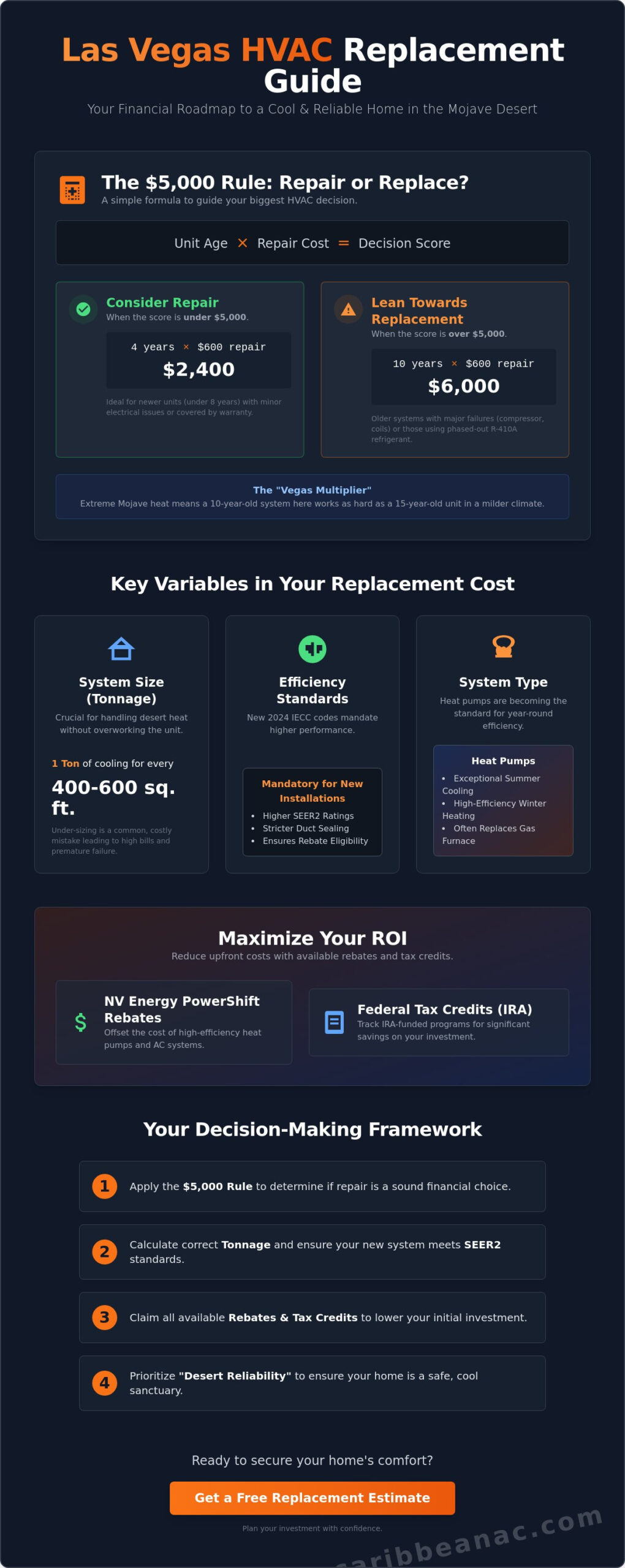
Deciding whether to fix a broken unit or invest in a new one is the biggest financial hurdle homeowners face. To simplify this, we use a manual Las Vegas hvac replacement cost calculator known as the $5,000 Rule. Take the age of your system and multiply it by the estimated repair cost. If the result exceeds $5,000, the data suggests that a full replacement is the more responsible financial choice. This simple math helps remove the emotional stress from a high-stakes decision.
This formula is especially critical in 2026 as HVAC system design standards have shifted toward higher efficiency and new refrigerants. While a $600 repair on a 4-year-old unit ($2,400) makes sense, that same repair on a 10-year-old unit ($6,000) is essentially throwing money away. In the Mojave Desert, the “Vegas Multiplier” applies; our extreme heat means a 10-year-old system has worked as hard as a 15-year-old system in a milder climate.
To better understand how these costs break down in the current market, watch this helpful video:
Beyond the age formula, consider the refrigerant. Systems manufactured before 2025 primarily use R-410A, which is being phased out in favor of lower-GWP alternatives like R-454B. As R-410A supplies dwindle, the cost of recharging an old, leaking unit will continue to skyrocket. This makes the “repair” option even less attractive for older systems that are prone to leaks.
When to Repair Your Las Vegas HVAC System
Repair is usually the right path for minor electrical failures, such as a blown capacitor or a faulty contactor, especially if the quote stays under $500. If your system is under 8 years old, it likely still carries a manufacturer parts warranty that covers major components. Consistent professional ac maintenance also extends the viable life of your unit, making repairs more predictable and effective.
When Replacement Becomes Unavoidable
Certain failures signal the end of the road. A failed compressor in a system over a decade old is almost always a sign to replace rather than repair. Similarly, leaking evaporator coils are expensive to fix and often lead to a cycle of constant refrigerant top-offs. If you find yourself making “emergency” service calls every time the thermostat hits 110 degrees, your system is no longer dependable for desert survival.
Key Variables in Your Las Vegas HVAC Replacement Cost
While a basic Las Vegas hvac replacement cost calculator provides a helpful starting point, the final investment depends on several desert-specific factors. Tonnage is your most critical variable. In the Mojave, we typically recommend one ton of cooling capacity for every 400 to 600 square feet of living space. Under-sizing a unit to save money is a common mistake that leads to a system running constantly without ever reaching your target temperature. This overworking significantly shortens the equipment’s lifespan and spikes your utility bills.
The 2026 efficiency landscape has also shifted. As of January 2026, both the City of Las Vegas and Clark County began enforcing the 2024 International Energy Conservation Code (IECC). These rules mandate higher SEER2 ratings and stricter duct sealing for all new installations. While these requirements increase the initial price, they ensure your system qualifies for various Federal tax credits and rebates. Proper permitting and inspections aren’t just red tape; they’re your guarantee that the system meets these new safety and performance codes.
System Type: Central Air vs. Heat Pumps
Heat pumps are rapidly becoming the preferred standard for homes in Henderson and Summerlin. Modern heat pumps provide exceptional cooling in the summer and highly efficient warmth during our mild winters, often removing the need for complex gas furnace setups. If you’re curious about how these units handle the colder months, explore our heater repair guide for a deeper look at heating-specific variables and costs.
The Desert Reliability Factor
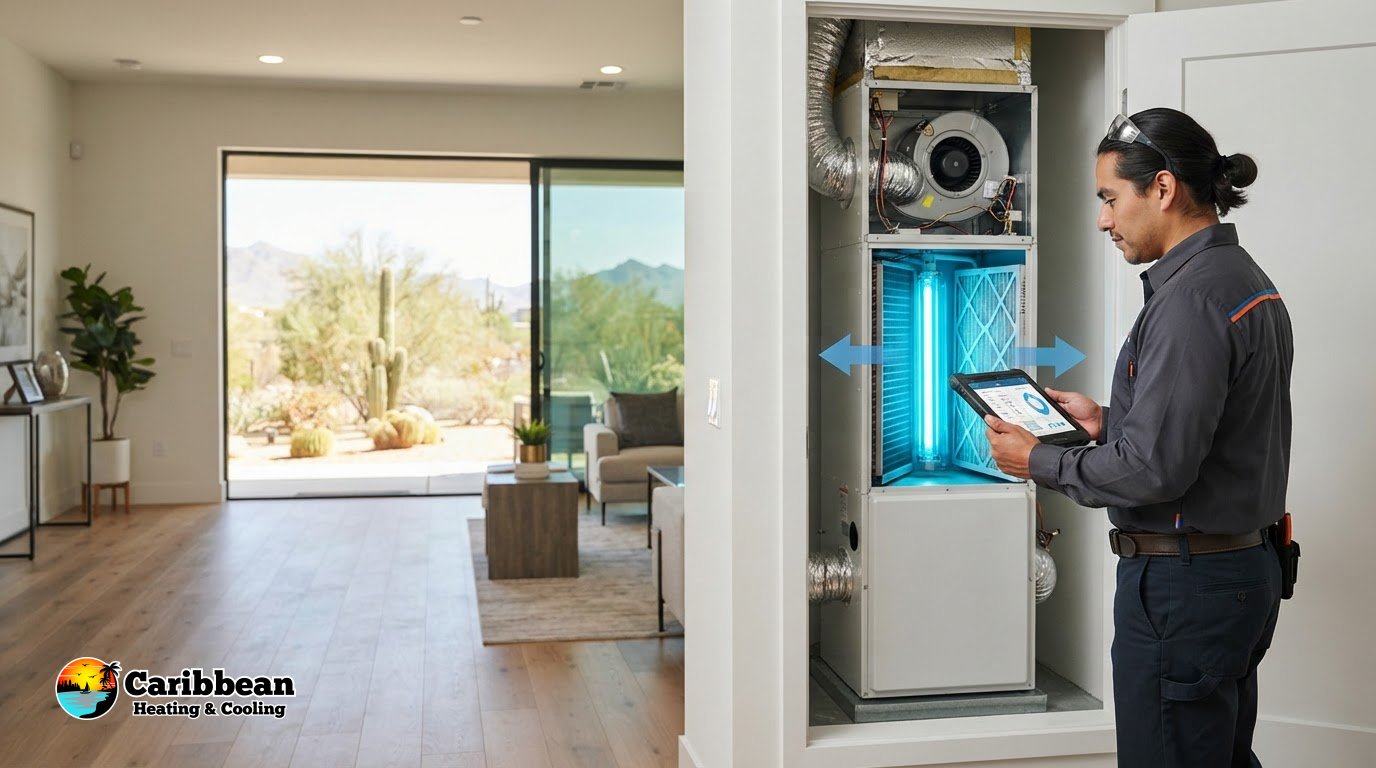
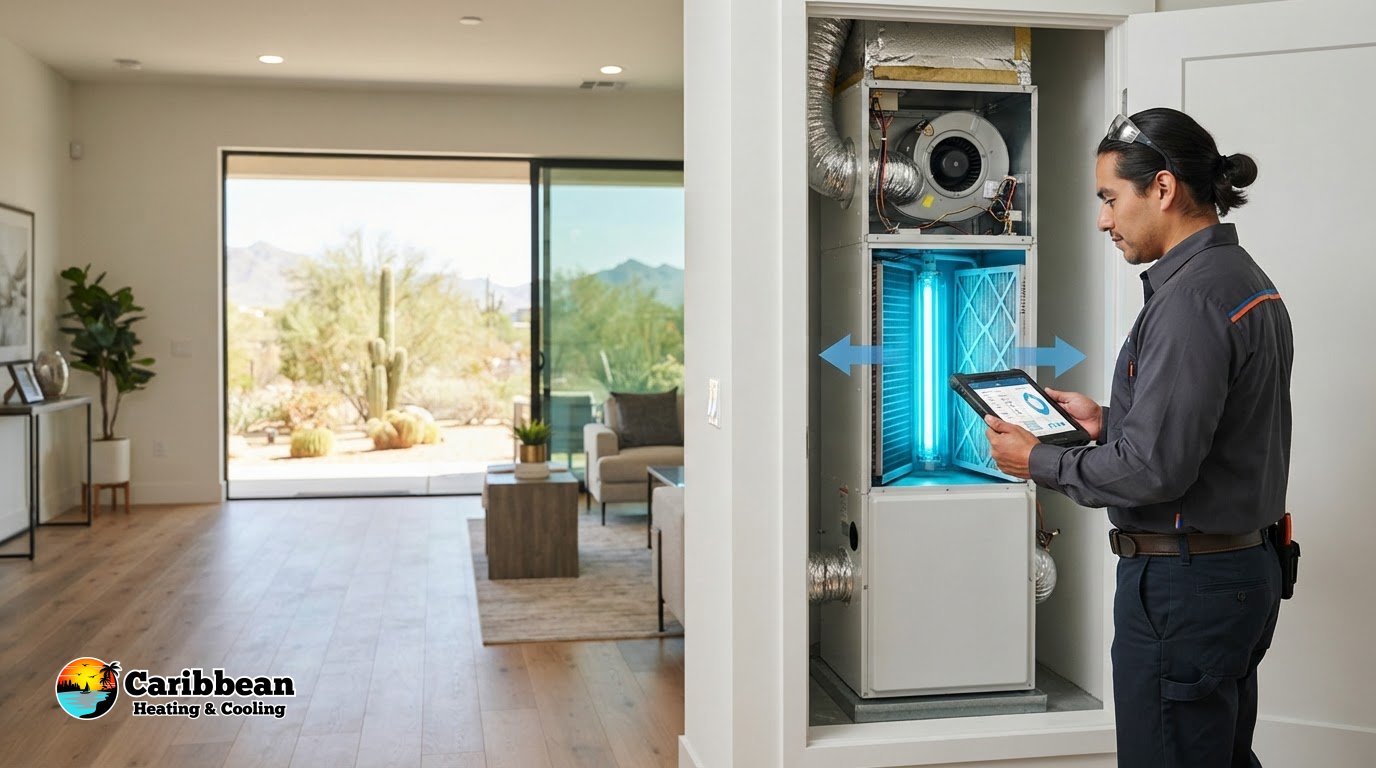
In Southern Nevada, we deal with a “Desert Tax” consisting of extreme heat and fine Mojave dust. High-quality filtration is essential to prevent silt from clogging your new coils and reducing efficiency. We often recommend integrating indoor air quality services during the installation phase to protect your investment. Even the placement of your condenser matters; a unit installed in direct afternoon sun will work harder and cost more to operate than one placed in a shaded area. If you’re ready to find the perfect fit for your home’s footprint, a professional HVAC installation assessment can provide the clarity you need.
Maximizing ROI: Rebates, Savings, and Long-Term Value
Investing in a new system isn’t just about the upfront sticker price; it’s about the long-term return on your investment in the harsh Nevada climate. When you use a Las Vegas hvac replacement cost calculator, it’s vital to factor in the significant financial incentives available in 2026. NV Energy’s PowerShift program remains a cornerstone for local savings, operating with an $11.1 million budget this year. Because these funds are distributed on a first-come, first-served basis, acting early in the year is often the best strategy to secure your rebate.
You can currently claim between $500 and $2,000 for high-efficiency heat pumps, while qualifying central AC units offer rebates from $300 to $1,200. Additionally, IRA-funded programs like HEAR and HOMES have been approved for Nevada households, offering potential savings of up to $2,000 on qualifying systems. These incentives, combined with $75 to $125 rebates for smart thermostats, drastically reduce the net cost of your ac installation and accelerate your path to total energy independence.
Calculating Your Energy Payback Period
Moving from an older SEER 10 unit to a modern SEER2 16+ system creates a dramatic shift in your monthly overhead. In the extreme heat of a Las Vegas summer, high-efficiency units often pay for themselves through utility savings alone within 5 to 7 years. Beyond the monthly bills, a reliable 10-year parts and labor warranty provides a safety net that protects you from the volatile costs of emergency repairs during peak cooling months.
Choosing the Right Partner for Your Replacement
A successful replacement requires a partner who understands that residential systems in the Mojave face unique stresses. We prioritize a service-oriented approach that ensures your new equipment is calibrated for maximum desert performance. Having a team that offers comprehensive, multi-disciplinary support is critical when you’re making a decade-long commitment to your home’s comfort. If you’re ready to move forward with confidence, get a detailed HVAC replacement estimate from Caribbean Heating & Cooling and secure your home’s sanctuary for the years ahead.
Secure Your Home Against the Mojave Heat
Choosing to replace your HVAC system is a significant step toward ensuring your family’s safety and comfort. By applying the $5,000 rule and prioritizing high-efficiency SEER2 units, you’re making a strategic investment that pays off through lower utility bills and improved reliability. Following the 2026 rebate landscape and new building codes doesn’t have to be overwhelming when you have a partner who understands the unique demands of our desert climate. While a manual Las Vegas hvac replacement cost calculator provides a solid baseline, a professional assessment is the only way to guarantee your home is perfectly equipped for the next decade of summer heatwaves.
At Caribbean Heating & Cooling, we’ve been family-owned and operated since 2018, specializing in solutions built for the specific challenges of Southern Nevada. We provide 24/7 emergency residential support to ensure you’re never left without cooling when it matters most. Don’t wait for your old unit to fail during a record-breaking July afternoon. Request Your Free Residential HVAC Replacement Quote Today and enjoy the peace of mind that comes with a high-performance system. We’re here to help you stay cool, save money, and master your home’s environment.
Frequently Asked Questions
How much does it cost to replace an HVAC system in Las Vegas in 2026?
A full HVAC replacement in the Las Vegas market during 2026 typically ranges between $7,500 and $16,000, with most homeowners spending between $10,000 and $12,500 for a mid-range system. When you use a Las Vegas hvac replacement cost calculator, remember that these figures cover the outdoor condenser and indoor air handler. If your home requires a full ductwork replacement, you should expect to add $3,000 to $7,000 to the total project cost.
Is a heat pump better than a central AC and furnace in the Nevada desert?
Heat pumps are often the superior choice for Southern Nevada because they provide both high-efficiency cooling and effective heating during our mild winters without the need for a separate gas furnace. They are particularly effective in Climate Zone 3B and qualify for the highest tiers of utility rebates. Modern heat pump technology is specifically designed to maintain performance even when summer temperatures exceed 110 degrees.
What is the $5,000 rule for AC replacement?
The $5,000 rule is a financial formula where you multiply the age of your HVAC unit by the quoted repair cost. If the resulting number is greater than $5,000, the data suggests that replacing the system is a better long-term investment than fixing it. In our local climate, this rule is especially helpful because the extreme heat accelerates wear and tear on older components.
Are there any NV Energy rebates available for new HVAC systems?
Yes, NV Energy has allocated an $11.1 million budget for the 2026 PowerShift program to help homeowners upgrade to high-efficiency systems. You can receive rebates ranging from $500 to $2,000 for high-efficiency heat pumps and $300 to $1,200 for qualifying central AC units. These rebates are distributed on a first-come, first-served basis, so it’s best to apply early in the year before the budget is exhausted.
How long does a typical HVAC installation take in Las Vegas?
Most standard residential HVAC installations are completed within a single day, usually taking between 8 and 12 hours of active work. If your project involves complex attic transitions or extensive ductwork repairs, the process may extend into a second or third day. We prioritize efficiency during the replacement process to ensure your home’s cooling is restored as quickly as possible.
What SEER2 rating do I need for my Las Vegas home?
Under the 2024 International Energy Conservation Code enforced as of January 2026, new systems in Las Vegas must meet strict efficiency standards. While the legal minimum for our region is 14.3 SEER2, most homeowners choose systems with ratings of 16 SEER2 or higher. Selecting a higher rating not only ensures compliance with the new building codes but also maximizes your eligibility for the best NV Energy rebates.

Related Posts
Comments (0)