
El costo de instalación de una bomba de calor en North Las Vegas depende del tipo y la capacidad del sistema, los ductos y la instalación eléctrica...
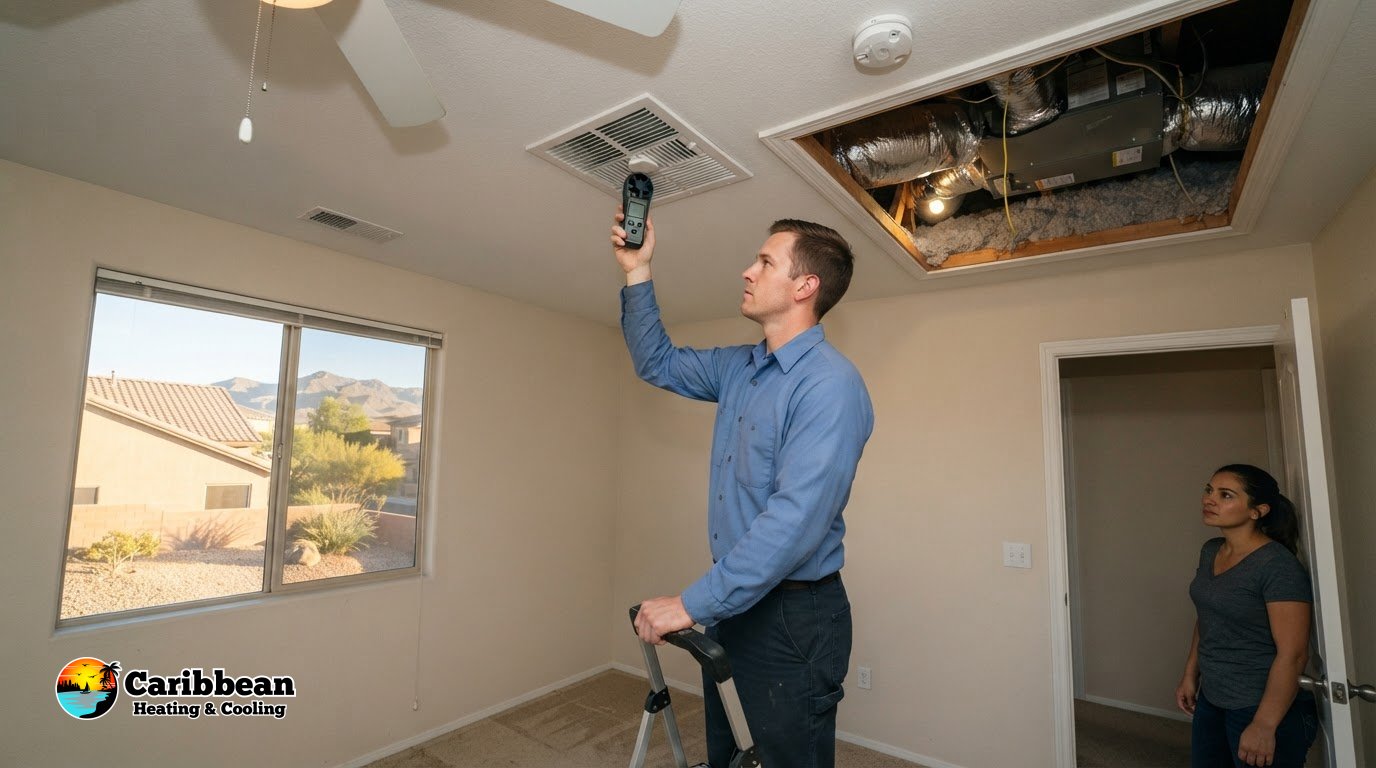
HVAC for Poorly Insulated Summerlin Homes: Central AC or Heat Pump
An inverter heat pump can maintain cooling capacity in Las Vegas temperatures above 115 degrees, so poor insulation alone doesn’t rule it out. Choosing the best HVAC system for a house with bad insulation in Summerlin means comparing a heat pump with central AC, considering the home’s ducts and cooling needs, and looking at 18 SEER2 or higher for summer energy efficiency.
If your Summerlin home struggles to stay cool, it’s natural to wonder whether a heat pump can handle the desert heat or whether central AC is the better fit. The answer depends on more than equipment: insulation and duct condition affect how well cooled air reaches each room.
This guide explains how the two systems compare, what SEER2 rating to consider, and when repair, replacement, installation, or maintenance may make sense. You’ll have a clearer way to weigh comfort and efficiency before deciding on your next step.
Key Takeaways
- Use symptoms such as poor airflow, uneven cooling, or inaccurate thermostat readings to decide when an AC repair assessment is needed.
- Compare system options by looking beyond equipment type: home size, insulation, duct condition, and window orientation all affect the right fit.
- A Manual J load calculation helps match cooling capacity to the home and avoid equipment that cools too quickly.
- Keep performance on track with pre-season maintenance and regular filter changes, especially during Southern Nevada’s demanding cooling season.
Air conditioner repair, replacement, installation, and maintenance
In a poorly insulated Summerlin home, an AC problem may come from the equipment or the path cooled air travels. Leaky or uninsulated ducts can waste 20 to 30 percent of the energy used to run central air conditioning. Poor airflow, uneven cooling, and inaccurate thermostat readings are signs to arrange a repair assessment.
Before replacement or installation, consider the system’s age, condition, and efficiency rating alongside the home’s insulation and ductwork. A high-quality desert climate control system typically lasts 10 to 15 years with professional maintenance; homeowners may wait 15 years or more before considering replacement. Installation also affects performance: airflow balance, refrigerant charge, duct sealing, and thermostat placement all matter. Variable-speed equipment can adjust output rather than repeatedly switching fully on and off.
| Option | Useful when | Performance focus |
|---|---|---|
| Repair | Cooling or airflow changes | Find mechanical faults |
| Replacement | Older equipment needs evaluation | Match capacity and rating |
| Installation | A system is being added or replaced | Balance airflow and seal ducts |
| Maintenance | Before extreme summer or winter weather | Clean coils and inspect operation |
Schedule professional HVAC maintenance twice a year, once before summer and once before winter. Between visits, change air filters every 1-3 months. Dirty coils, clogged filters, and low refrigerant can reduce efficiency, while regular checkups help keep performance steady and identify issues early. Keep outdoor equipment clear of obstructions so it can operate as intended.
Choose repair for a specific fault, replacement for aging or unsuitable equipment, and maintenance to support long-term energy savings and equipment life.
What SEER2 rating is recommended for Southern Nevada?
For Southern Nevada, consider at least 16 SEER2; 18 SEER2 or higher is recommended for summer energy efficiency. Las Vegas summer peaks can exceed 115 degrees, so a strong rating matters, but it doesn’t determine the system’s required cooling capacity. Home size, insulation, window orientation, and duct condition all affect the home’s load.
Ask for a Manual J load calculation from the Air Conditioning Contractors of America’s recognized method. It estimates the cooling capacity needed for the home rather than relying on square footage alone. One ton of central air conditioning equals 12,000 Btu/hr. An oversized system can cool rooms quickly and shut off before removing enough humidity, affecting comfort and operation. Accurate sizing can also help avoid unnecessary repairs and utility use.
Summerlin’s hot desert climate brings prolonged cooling demand and extreme outdoor temperatures. Insulation, sun-facing windows, and duct losses all affect system sizing, so equipment should match the home’s calculated cooling load rather than simply have a high rating.
For HVAC replacement in Clark County, the project scope matters. Identify whether the work changes equipment, electrical connections, or ductwork, then determine which local permit and code requirements apply before installation. Nevada or federal rebates and tax credits depend on the specific upgrade and program criteria, so count incentives only when the equipment or insulation work meets those requirements.
Use the Manual J result to compare SEER2 ratings against required capacity, then assess the system’s condition before deciding on repairs or replacement. If cooling operation changes, an AC system assessment can help identify performance issues.
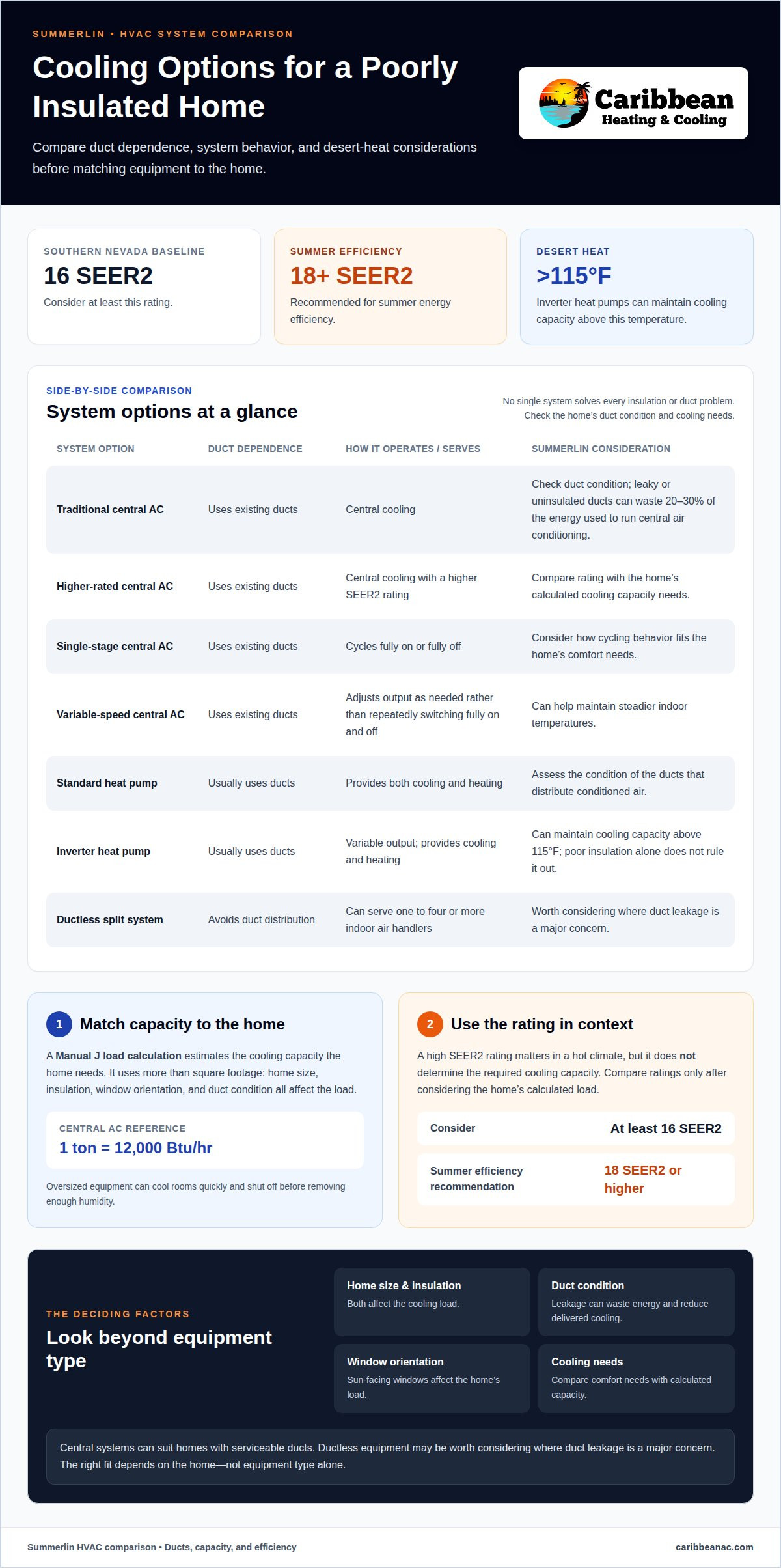
What HVAC systems work best for poorly insulated homes in Summerlin, Las Vegas?
No single system compensates for every insulation or duct problem. In Summerlin, compare central AC and heat pumps alongside duct condition, home size, and local microclimate. Modern inverter heat pumps can maintain cooling capacity above 115 degrees, while ductless systems avoid energy loss through leaky ducts. Variable-speed compressors adjust output instead of cycling only fully on or off, helping maintain steady indoor temperatures.
Use this comparison to narrow the options before matching equipment to your home’s cooling load:
| System option | Duct dependence | Summerlin consideration |
|---|---|---|
| Traditional central AC | Uses existing ducts | Check duct condition |
| Higher-rated central AC | Uses existing ducts | Compare SEER2 rating |
| Single-stage central AC | Uses existing ducts | Cycles fully on or off |
| Variable-speed central AC | Uses existing ducts | Adjusts output as needed |
| Standard heat pump | Usually uses ducts | Provides cooling and heating |
| Inverter heat pump | Usually uses ducts | Maintains cooling above 115 degrees |
| Ductless split system | Avoids duct distribution | Can serve one to four or more indoor air handlers |
Central systems can suit homes with serviceable ducts; ductless equipment may be worth considering where duct leakage is a major concern. A heat pump provides both cooling and heating, while central AC focuses on cooling. The best HVAC system for a house with bad insulation in Summerlin depends on the home’s size, insulation, ductwork, and cooling needs, not equipment type alone.
Compare suitable equipment with a technician and review HVAC system options for your home.
Central AC uses ducts to provide cooling, while heat pumps generally use ducts for both cooling and heating. Ductless mini-splits avoid losses through leaky ducts and can serve one or more indoor air handlers. Evaporative coolers are outside this comparison.
Caribbean Heating & Cooling: AC Repair
Caribbean Heating & Cooling provides AC repair when poor airflow, uneven cooling, or inaccurate thermostat readings point to a system problem. An assessment can help distinguish a repairable fault from issues involving equipment condition or installation. If replacement is the better fit, AC installation can match new equipment to the home’s cooling needs. Regular AC maintenance supports reliable operation, while heating repair addresses problems with home heating.
Share symptoms you’ve noticed, such as rooms that stay warm or cooling that feels inconsistent. This helps focus the service on the issue affecting comfort, rather than assuming insulation is the only cause.
For help with an AC concern, contact Caribbean Heating & Cooling.
Take the Next Step Toward Steadier Comfort
Choosing the best HVAC system for a house with bad insulation in Summerlin starts with observing how your home feels during daily use. Note which rooms are uncomfortable, when temperatures drift, and whether the problem changes after the system runs. These patterns help focus an HVAC assessment on your home’s comfort needs rather than assumptions based on equipment alone.
Think of the next step as a way to make your home more comfortable through changing seasons. A focused conversation can clarify whether the priority is diagnosing a current problem, planning an equipment change, or keeping the existing system working reliably. The right approach depends on the system’s condition and the comfort issues you’re experiencing.
Reach out to Caribbean Heating & Cooling to discuss your home’s cooling needs and move toward a more comfortable space.
Frequently Asked Questions
Are heat pumps effective when Las Vegas hits 115 degrees?
Yes, modern inverter heat pumps can maintain cooling capacity when Las Vegas temperatures rise above 115 degrees. Their variable output helps match cooling to changing demand instead of relying only on full-power cycles. For a poorly insulated home, also consider whether cooled air reaches each room effectively. A heat pump can perform well, but insulation and distribution still shape indoor comfort.
How do I choose the best HVACR system for Las Vegas heat?
Choose a system based on how your home handles heat, not equipment type alone. Persistent hot rooms may point to duct leakage or uneven air distribution, while whole-home cooling problems may call for a broader system assessment. Compare central AC, heat pumps, and ductless options against your household’s heating needs, duct layout, and comfort patterns.
How long does a climate control system last in the desert?
A high-quality climate control system in the desert typically lasts 10 to 15 years with professional maintenance. The equipment’s workload, upkeep, and operating condition influence its useful life. Keep records of recurring faults and performance changes; if repairs become frequent or comfort declines, those details help clarify whether maintaining the current system remains practical.
What HVAC load calculation is recommended for a poorly insulated Summerlin home?
Use a Manual J load calculation to estimate your home’s cooling requirements. For a useful assessment, gather a floor plan and note window orientation, insulation concerns, and rooms that remain uncomfortable. These details help identify differences in heat gain across the house. Avoid choosing capacity based on square footage alone, since homes of similar size can have different cooling loads.
Which SEER2 and HSPF2 ratings are most cost-effective for homes in Southern Nevada?
Consider at least 16 SEER2 for Southern Nevada, with 18 SEER2 or higher as a summer-efficiency target. HSPF2 rates a heat pump’s seasonal heating efficiency, so compare it when heating performance matters alongside cooling. The most cost-effective choice depends on the home’s cooling and heating use, insulation, and equipment match, not the rating alone.

Related Posts
Comments (0)