
Son las 2:00 a. m. en Anthem y, aunque las estrellas del desierto son hermosas, el aire a 38 grados Fahrenheit (3 °C) que se cuela por sus ventanas...
Heat Pump vs. AC in Las Vegas: Which Is Best for Your Desert Home? (2026)
What if the same system that keeps you cool in 110-degree July heat could also slash your winter heating costs? Many homeowners assume a traditional central air conditioner is the only way to survive a Nevada summer, but the heat pump vs ac las vegas debate is changing as local energy rates shift. With residential electricity rates at $0.11622 per kWh through September 2026, choosing an inefficient system leads directly to those dreaded triple-digit utility bills.
We understand the stress of maintaining a comfortable home when the desert sun is relentless. This guide identifies the critical differences between heat pumps and traditional units to help you choose the most reliable, cost-effective solution for your property. We’ll preview the latest NV Energy PowerShift rebates and explain how the right choice can save a typical 2,000-square-foot home up to $500 annually on energy costs.
Key Takeaways
- Learn how a heat pump functions as a versatile, year-round climate manager by using a reversing valve to provide both cooling and heating from a single unit.
- Compare the operational costs of all-electric systems versus traditional gas-electric pairings when deciding on a heat pump vs ac las vegas for your home.
- Identify the 2026 SEER2 and HSPF2 efficiency standards required to maximize your comfort and qualify for local utility rebates in Southern Nevada.
- Understand why professional sizing through a Manual J calculation and an electrical panel assessment are critical to ensure your system survives the extreme stress of a desert summer.
Decoding the Mechanics: How Heat Pumps and AC Units Differ
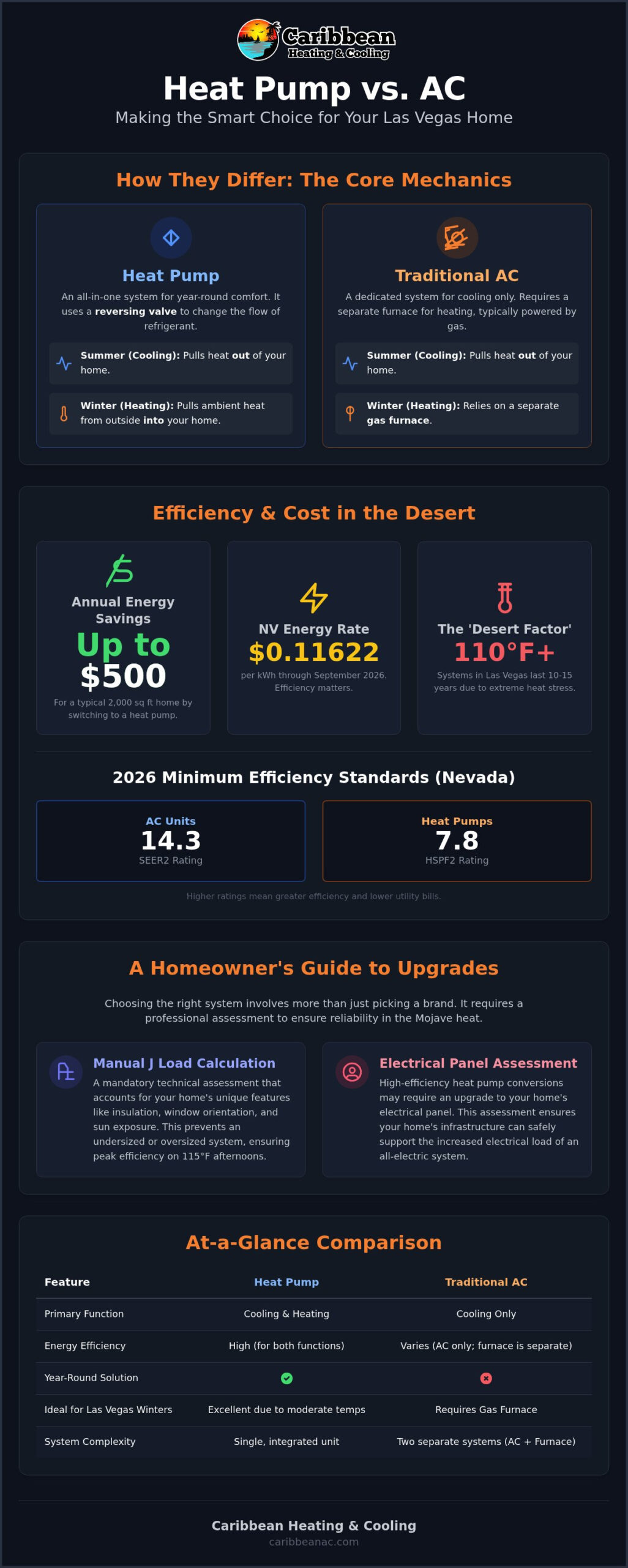
Most homeowners don’t realize that a heat pump is essentially an air conditioner equipped with a clever component called a reversing valve. This specific valve allows the system to change the direction of refrigerant flow, meaning it can pull heat out of your home in July or pull heat from the outside air into your home during a chilly January night. To understand the physics, it helps to look at the thermodynamics of how heat pumps and air conditioners work. This dual-purpose design eliminates the need for separate systems in many Henderson and Summerlin homes.
Traditional setups are different. A standard AC unit only handles cooling; it requires a separate gas furnace to provide warmth. While this was the desert standard for decades, modern 2026 heat pump technology is now engineered to handle 110°F days without losing its cooling efficiency. This makes the choice of heat pump vs ac las vegas more about your home’s specific infrastructure and energy goals than just raw cooling power.
To better understand this concept, watch this helpful video:
Why the Las Vegas Climate Favors Air-Source Heat Pumps
Our moderate winters are perfect for air-source technology. Unlike older electric strip heating that consumes massive amounts of power to create warmth, heat pumps move existing heat from one place to another. This process remains significantly more efficient in temperatures that rarely drop below freezing, making it a dependable choice for residential comfort throughout the valley.
During our long summers, these systems match the SEER2 performance of high-end traditional AC units, ensuring you don’t sacrifice comfort for versatility. In the Mojave Desert, the balance point is the specific outdoor temperature where the heat pump’s heating capacity exactly matches your home’s heat loss.
Efficiency and Cost: Comparing Performance in the Nevada Desert
Deciding between a heat pump vs ac las vegas often comes down to the monthly utility bill. In Southern Nevada, residential electricity rates sit at $0.11622 per kWh through late 2026. While a traditional air conditioner relies on a gas furnace for winter warmth, an all-electric heat pump manages both seasons with high efficiency. A family in a 2,000-square-foot home can save between $300 and $500 annually by switching to a heat pump. These savings are vital when comparing heat pumps and air conditioners for long-term value.
Performance is measured by SEER2 and HSPF2 ratings. In Nevada, the 2026 minimum SEER2 for split-system air conditioners is 14.3. Heat pumps must meet a minimum HSPF2 of 7.8. Higher ratings mean better efficiency during our extreme 110-degree summer spikes. Because a typical AC unit in Las Vegas lasts 10 to 15 years due to heat stress, choosing a high-efficiency model ensures the system pays for itself through lower consumption before it needs replacement.
The Gas vs. Electric Debate: What’s Best for Your Neighborhood?
Newer developments in Summerlin and Henderson are trending toward all-electric heat pumps to improve indoor air quality and simplify maintenance. However, some residents prefer dual-fuel or hybrid systems. These pair a high-efficiency heat pump with a gas furnace, offering a backup for the rare nights when temperatures dip significantly. To maximize these savings, we recommend smart thermostats that automatically switch between fuel sources based on current energy rates. If you’re still weighing a heat pump vs ac las vegas for your specific property, our team can provide a professional heat pump installation assessment to find your ideal match.
Choosing Your System: A Resident’s Guide to HVAC Upgrades
Selecting the right system in the heat pump vs ac las vegas debate requires a careful look at your home’s current infrastructure. High-efficiency heat pump conversions often demand an electrical panel assessment to ensure your home can support the increased load. We also prioritize the ‘Desert Factor’ by performing a mandatory Manual J load calculation for every project. This technical assessment accounts for your home’s insulation, window orientation, and sun exposure. It ensures your system isn’t undersized for a 115-degree afternoon or oversized and prone to inefficient short-cycling.
Reliability is your most valuable feature in the Mojave. We focus on systems with excellent local parts availability. When a component fails during a record-breaking July heatwave, waiting for a shipment from out of state is not an option. Our deep roots in the valley mean we understand which brands survive the unique grit and extreme thermal stress of our environment. Professional sizing and local support are what keep a home comfortable when the desert is at its harshest.
Professional Installation and Maintenance with Caribbean Heating & Cooling
Our team guides you through the entire AC installation process. We start with precise load calculations and finish with comprehensive testing to verify airflow and refrigerant levels. Because our environment is uniquely dusty, regular AC maintenance is non-negotiable. It keeps your heat pump running efficiently through both the summer peaks and winter lows. To ensure your family stays safe, we provide 24/7 emergency residential support for those moments when you need immediate professional help. Beyond climate control, ensuring your household has a steady supply of clean water is vital, and A Clear Alternative offers specialized bulk water delivery services to support total home resilience.
Secure Your Home’s Year-Round Comfort in the Mojave
Choosing the right HVAC system is one of the most significant decisions you’ll make for your desert home. Whether you opt for a versatile all-electric heat pump or a traditional high-efficiency AC and furnace pairing, prioritizing professional sizing and local expertise is essential. The right heat pump vs ac las vegas decision can lower your monthly bills while providing the reliable cooling you need during our 110-degree summer spikes.
As family-owned local experts since 2018, we specialize in high-efficiency desert cooling solutions tailored to our unique climate. We provide 24/7 emergency residential support to ensure you never face a breakdown alone. Schedule your residential HVAC consultation with Caribbean Heating & Cooling today! We’re here to help you build a more comfortable, energy-efficient future for your family in the Las Vegas valley.
Frequently Asked Questions
Do heat pumps really work in the extreme Las Vegas summer heat?
Yes, modern heat pumps are specifically designed to handle temperatures exceeding 110°F. When comparing a heat pump vs ac las vegas, the cooling performance is identical because both systems use the same refrigeration cycle. High-efficiency units with a SEER2 rating of 14.3 or higher ensure your home stays comfortable during record-breaking Henderson and Summerlin heatwaves without failing under the extreme thermal load.
Is it cheaper to run a heat pump or a gas furnace in Nevada?
For most Southern Nevada residents, a heat pump is more cost-effective than a standalone gas furnace. Because our winters are relatively mild, a heat pump moves heat rather than generating it, which uses significantly less energy. With NV Energy electricity rates at $0.11622 per kWh in late 2026, a typical family can save hundreds of dollars annually compared to traditional gas-electric pairings.
What is the average lifespan of a heat pump in the desert climate?
What is the average lifespan of a heat pump in the desert climate?
In the harsh Mojave Desert, a heat pump typically lasts between 10 and 15 years. This is slightly shorter than the 20-year lifespan seen in cooler regions because the system works much harder during our long cooling seasons. Professional maintenance and timely repairs are essential to protect your investment; you can learn more about professional maintenance standards to ensure the system operates reliably through every triple-digit summer.
You can definitely integrate a heat pump with your existing gas furnace to create a dual-fuel system. This hybrid approach is popular in North Las Vegas homes. The heat pump provides efficient cooling and moderate heating, while the furnace provides a powerful backup for the rare freezing nights. This configuration offers the best of both worlds for desert versatility and energy management.

Related Posts
Comments (0)